Best Garage Heaters for a Cold Workshop
Choosing the best garage heaters for a cold workshop comes down to one number most buyers skip: how much heat your building actually loses per hour. Get that wrong and you either freeze beside an undersized unit or pay to run an oversized one that short cycles all winter. This guide gives you the sizing math first, then six units that hold up in real shops.
I have wired, mounted, and commissioned heaters in workshops for over a decade, and the same three mistakes come up every season. People buy on wattage alone, they ignore ceiling height, and they run combustion heaters without a carbon monoxide alarm. All three are fixable in an afternoon.
This post contains affiliate links. We earn a commission when you purchase through our links at no extra cost to you. We only recommend products we’ve personally tested and use ourselves.
Quick Verdict
- Best overall: Fahrenheat FUH54, a 5,000W 240V ceiling unit that suits most insulated two car shops.
- Best portable electric: Dr. Infrared Heater DR-988, 7,500W with a roll cage and a long cord.
- Best for an uninsulated shop: King KB2410-1-B2-ECO, 10,000W of brute force with smart controls.
- Cheapest to run: Modine Hot Dawg HD45AS0111 natural gas unit heater at 80 percent thermal efficiency.
- Best with no electrical work: Mr. Heater Big Buddy MH18B propane heater with an oxygen depletion sensor.
- Best spot heat on a standard outlet: Heat Storm HS-1500-PHX-WIFI infrared panel.
How to Size a Garage Heater Without Guessing
Home sizing charts assume insulated drywall and a sealed envelope. Workshops are different, which is why shop heater calculators use 30 to 50 BTU per square foot instead of the 20 BTU figure used for living space. Concrete floors, thin steel doors, and frequent door openings are the reason.
Run the volume calculation
Multiply length by width by ceiling height to get cubic feet. Multiply that by your temperature rise, which is your target temperature minus the coldest outdoor temperature you plan to work in. Then apply an insulation factor of 1.0 for excellent insulation, 1.5 for basic batts, and 2.0 or higher for bare studs.
A 24 by 24 shop with 10 foot ceilings holds 5,760 cubic feet. Aiming for a 50 degree rise puts you near 38,000 BTU before any insulation penalty. That single calculation separates a unit that keeps up from one that runs flat out and never reaches setpoint.
Convert watts to BTU
Electric heaters are sold in watts and gas heaters in BTU, which makes comparison shopping confusing. One watt equals roughly 3.41 BTU per hour, so a 5,000W unit delivers about 17,050 BTU. Keep that conversion handy when you compare across fuel types in the table below.
Insulate before you upsize
An uninsulated shop can need 30 percent to double the capacity of an identical insulated one. ENERGY STAR R-value guidance is the cheapest heating upgrade you will ever buy. Weatherstripping the overhead door and sealing the top plate gap often cuts required BTU enough to drop a whole heater size.
Do not skip carbon monoxide protection
Any fuel burning heater demands a working CO alarm and real ventilation. CDC data records an average of 430 unintentional non fire carbon monoxide deaths per year in the United States, and over 100,000 emergency room visits annually, with cases peaking in December and January. Those are the exact months your shop door stays shut.
If you are also running a generator or combustion equipment in the same space, pair the heater with a monitor. Our roundup of voltage testers for generator hookups covers the electrical side of the same setup.
Garage Heater Comparison Table
| Model | Fuel | Output | Coverage | Mount |
|---|---|---|---|---|
| Fahrenheat FUH54 | 240V electric | 5,000W / 17,050 BTU | Up to 500 sq ft | Ceiling or wall |
| Dr. Infrared DR-988 | 240V electric | 7,500W / 25,500 BTU | Up to 600 sq ft | Portable |
| King KB2410-1-B2-ECO | 240V electric | 10,000W / 34,100 BTU | Up to 800 sq ft | Ceiling or wall |
| Modine Hot Dawg HD45AS0111 | Natural gas | 45,000 BTU | Up to 1,000 sq ft | Ceiling, vented |
| Mr. Heater Big Buddy MH18B | Propane | 4,000 to 18,000 BTU | Up to 450 sq ft | Portable |
| Heat Storm HS-1500-PHX-WIFI | 120V electric | 1,500W / 5,115 BTU | Spot heat, 200 sq ft | Wall |
1. Fahrenheat FUH54: Best Overall Garage Heater
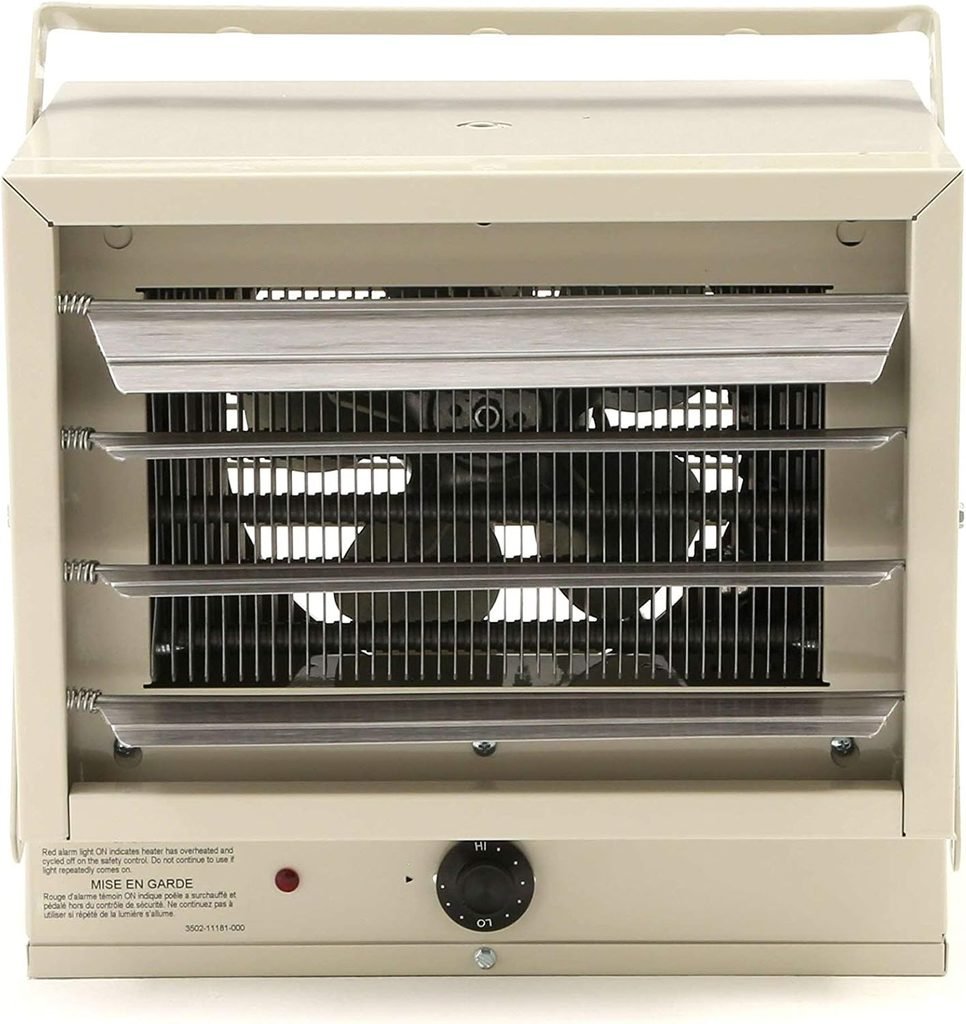
The FUH54 is the default recommendation for a reason. It bolts to the ceiling on the included bracket, frees up floor and wall space, and pushes 5,000W through adjustable louvers you can aim at the bench. A built in thermostat holds setpoint without babysitting.
It needs a dedicated 240V circuit, so budget for an electrician unless you are qualified to pull the wire yourself. For an insulated two car shop up to about 500 square feet, this is the unit that quietly does the job for years. The steel housing and epoxy finish tolerate sawdust and shop grime.
Pros
- Zero floor footprint
- Accurate built in thermostat
- Directional louvers
- Widely available parts
Cons
- Requires a 240V circuit
- Struggles in bare stud shops
- Fan noise at full output
Verdict: 9.3 / 10. The safest buy for a normally insulated workshop that already has panel capacity.
2. Dr. Infrared Heater DR-988: Best Portable Electric
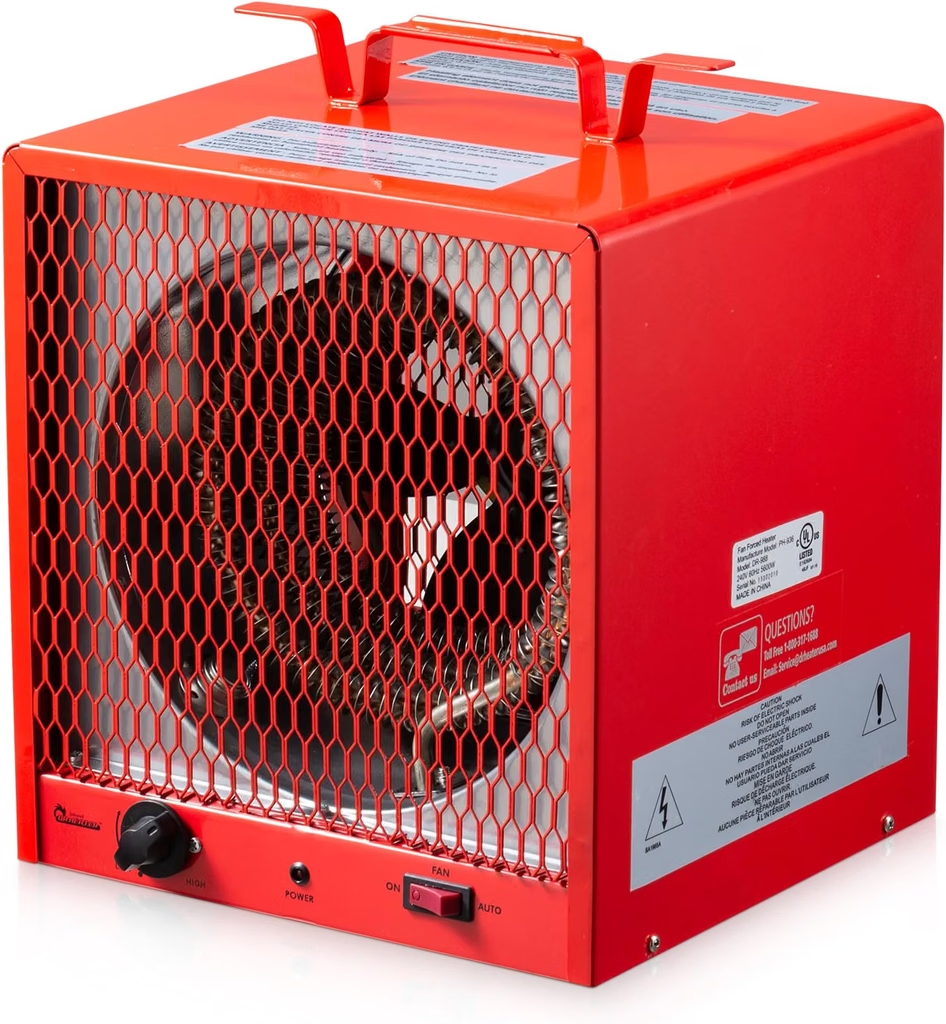
If you rent, or if your bench moves around the shop, the DR-988 gives you 240V output without a permanent install. It runs 7,500W through a heavy roll cage frame and draws on a NEMA 6-50 style plug, the same family many welders use. That makes it a natural fit in shops already wired for MIG welding.
Recovery time is the headline feature here. It will lift a cold 500 square foot bay noticeably within fifteen minutes, which matters when you only work weekends. The trade off is a bulky unit that takes up floor space and a fan that is clearly audible.
Pros
- No hardwiring needed
- Fast temperature recovery
- Rugged roll cage
- Moves between bays
Cons
- Occupies floor space
- Loud at high setting
- Needs a matching 240V receptacle
Verdict: 9.0 / 10. The best answer when you want 240V heat but cannot commit to a ceiling install.
3. King KB2410-1-B2-ECO: Best for an Uninsulated Shop
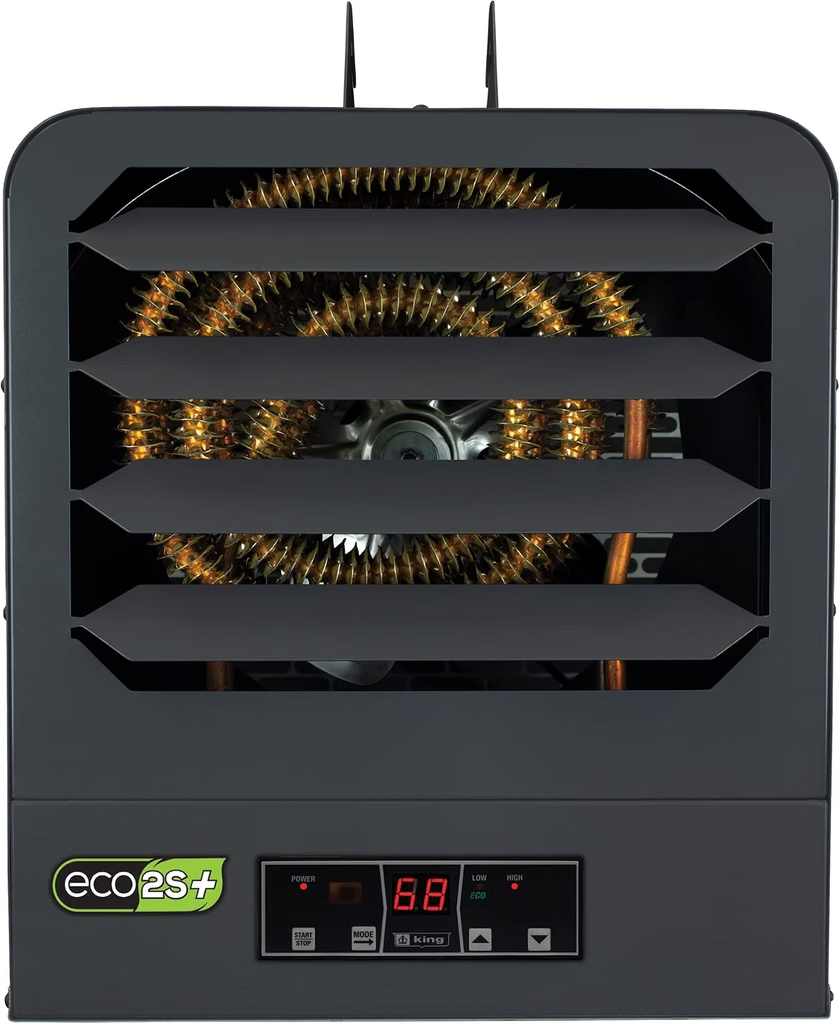
When the walls are bare studs and the door is single skin steel, 5,000W simply loses the race. The King delivers 10,000W, roughly 34,100 BTU, and its ECO controller modulates output instead of slamming between full on and full off. That reduces the temperature swing that makes cheap heaters feel drafty.
King publishes realistic coverage guidance that drops sharply with poor insulation, which is refreshingly honest for this category. Expect a serious circuit requirement at 42 amps or more. Treat this as a heater you buy alongside a panel assessment, not instead of one.
Pros
- Genuine output for cold shops
- Modulating ECO control
- Remote thermostat compatible
- Commercial grade build
Cons
- Heavy electrical demand
- Higher running cost than gas
- Overkill for small bays
Verdict: 8.8 / 10. The electric option that actually wins against a leaky building envelope.
4. Modine Hot Dawg HD45AS0111: Cheapest to Run
Natural gas is the cheapest fuel per delivered BTU in most of the country, and the Hot Dawg is the unit that made residential gas shop heating mainstream. It produces 45,000 BTU at 80 percent thermal efficiency and power vents through a side wall, which simplifies retrofits. Coverage lands near 1,000 square feet in a reasonably tight building.
It is also the quietest unit in this roundup, which matters if you record content or take calls in the shop. Installation is the catch. Gas line work and venting belong to a licensed professional, and most jurisdictions require a permit.
Pros
- Lowest operating cost
- Very quiet in use
- Vented, so no indoor combustion byproducts
- Low profile ceiling mount
Cons
- Highest upfront and install cost
- Permit usually required
- Needs an existing gas supply
Verdict: 9.1 / 10. The long term winner if you heat the shop most days through winter.
5. Mr. Heater Big Buddy MH18B: Best With No Electrical Work
Some shops have no spare breaker and no gas line, and the Big Buddy exists for exactly that situation. It runs cordless on two one pound cylinders or on a hose to a bulk tank, and steps between 4,000, 9,000, and 18,000 BTU. Setup takes minutes rather than a weekend.
The oxygen depletion sensor and tip over shutoff are what make it indoor rated, and you should treat those as non negotiable when comparing propane units. Crack a door or window two to four inches and fit a CO alarm anyway. Combustion also releases moisture, so expect condensation on cold tool surfaces.
Pros
- No wiring or install
- Three output settings
- Oxygen depletion sensor fitted
- Works during a power outage
Cons
- Requires active ventilation
- Adds humidity to the shop
- Ongoing cylinder cost
Verdict: 8.5 / 10. The right call for occasional use and for shops with no electrical headroom.
6. Heat Storm HS-1500-PHX-WIFI: Best Spot Heat on a Standard Outlet
Heating an entire 800 square foot building to stain one cabinet door is wasteful. This 1,500W infrared panel plugs into a normal 120V outlet, mounts on the wall above the bench, and warms objects rather than air. App scheduling means the bench area is warm before you walk in.
Do not expect it to heat a whole shop, because 5,115 BTU will not touch a cold two car bay. Used correctly as a bench level supplement beside a main heater, it is excellent. Pair it with decent work gloves and the cold stops being a reason to skip the shop.
Pros
- Plugs into any 120V outlet
- Silent radiant heat
- App scheduling
- Slim wall footprint
Cons
- Not a whole shop solution
- Line of sight heating only
- Limited output ceiling
Verdict: 8.0 / 10. A smart supplement, and the only pick here that needs no new circuit at all.
Scored Summary
| Model | Best For | Score |
|---|---|---|
| Fahrenheat FUH54 | Insulated two car shops | 9.3 |
| Modine Hot Dawg HD45AS0111 | Daily winter use | 9.1 |
| Dr. Infrared DR-988 | Portable 240V heat | 9.0 |
| King KB2410-1-B2-ECO | Uninsulated shops | 8.8 |
| Mr. Heater Big Buddy MH18B | No electrical capacity | 8.5 |
| Heat Storm HS-1500-PHX-WIFI | Bench spot heating | 8.0 |
Frequently Asked Questions
What size heater do I need for a two car garage?
A well insulated 400 to 500 square foot bay usually needs 10,000 to 20,000 BTU. The same bay uninsulated in a cold climate can need 40,000 to 60,000 BTU. Run the cubic foot calculation above before committing.
Is electric or propane cheaper for a workshop?
Electric is usually cheaper below roughly 20,000 BTU of demand. Above that, propane and especially natural gas pull ahead on running cost. Natural gas is the cheapest fuel overall where a line already exists.
Can I run a propane heater in a closed garage?
No. Indoor rated propane heaters still need fresh air, so keep a door or window open two to four inches. Fit a carbon monoxide alarm regardless of what the manual implies.
Do I need a permit to install a garage heater?
Most jurisdictions require a permit for hardwired 240V units and for any gas appliance. Portable plug in heaters generally do not. Check with your local building department before you buy.
Will a garage heater damage my tools?
Vented and electric heaters are fine. Unvented combustion heaters release water vapour that can settle on cold cast iron surfaces. Wipe down machine tables and keep a rust preventative handy if you use propane.
Still deciding between fuel types?
Run your shop dimensions through the tool finder quiz, then check the project checklist to see what else your winter build list needs. You can also put two models head to head in our side by side comparison tool.
Also Read On:
Milwaukee vs DeWalt vs Ryobi: Which Cordless Tool Platform Wins in 2026?
Best Voltage Tester for Generator Hookup: Verify Dead Circuits First