Snap-on vs Mac Tools: Are They Worth the Money in 2026?
This post contains affiliate links. We earn a commission when you purchase through our links at no extra cost to you.
Snap-on vs Mac Tools is one of the oldest arguments in any repair shop. Both brands roll up to your bay in a tool truck, both promise lifetime hand tool warranties, and both charge prices that make new technicians wince.
So are they actually worth the money? This guide breaks down price, build quality, warranty, financing, and the tool truck experience so you can decide where your hard-earned paycheck should go.
Quick Verdict
Snap-on wins on quality, innovation, and resale value. Mac Tools wins on value among truck brands.
- Buy Snap-on if you turn wrenches for a living, you use a tool every day, and a weekly truck visit saves you real downtime.
- Buy Mac Tools if you want truck service and a lifetime warranty but need a lower price on core hand tools and storage.
- Buy neither if you work on your own car a few weekends a year. A quality mid tier brand will serve you just as well for far less.
By the Numbers
- Snap-on reported $4.7 billion in net sales for 2025 and lists more than 85,000 SKUs in its product line (Snap-on).
- Snap-on runs 4,700 mobile stores worldwide, including more than 3,400 franchise vans in the United States.
- Morningstar estimates Snap-on holds roughly 60% share of mobile tool distribution for auto repair (Morningstar).
- Mac Tools, owned by Stanley Black & Decker, sells through a franchise network of roughly 1,500 distributors in North America.
- About 805,600 automotive service technician jobs in 2024, with a median wage of $49,670 (BLS).
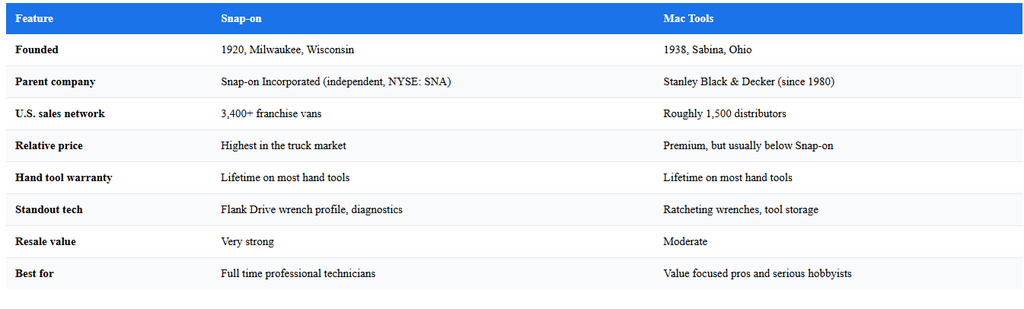
Snap-on vs Mac Tools at a Glance
Before we dig into the details, here is how the two brands stack up side by side. Use this table as a quick reference while you read.
Who Makes Snap-on and Mac Tools?
Snap-on: The Brand That Built the Tool Truck
Snap-on started in 1920 with a simple idea of interchangeable sockets that snapped onto a handful of handles. The company moved to Kenosha, Wisconsin in 1930 and grew into the most recognized name in professional automotive tools.
Today Snap-on reports 13,000 employees, more than 4,530 active and pending patents, and 15 manufacturing facilities in the United States. Its 2025 annual results show a business that stays highly profitable even in a soft market.
One number tells you a lot about the current mood among mechanics. Snap-on’s Tools Group, the segment that sells through vans, posted 2025 sales of about $1.96 billion, down 1.2% from 2024, as technicians shifted toward quick payback purchases.
Mac Tools: The Stanley Black & Decker Challenger
Mac Tools began in 1938 as the Mechanics Tool and Forge Company in Sabina, Ohio. Stanley bought the brand in 1980, which puts Mac in the same family as DeWalt, Proto, Facom, and Craftsman.
That ownership shapes the product line. Mac sources tools from several Stanley Black & Decker plants around the world, builds tool storage in Allentown, Pennsylvania, and makes some hand tools at the Proto plant in Dallas.
Mac’s distributor network is smaller than Snap-on’s, but it still covers most metro areas. Trade press has also reported Mac trucks operating in Canada, the UK, and Japan (Vehicle Service Pros).
Price: Why Truck Tools Cost So Much
Let’s be honest about the elephant in the toolbox. Both brands cost several times more than big box store brands, and Snap-on usually sits at the very top of that range.
You are not just paying for steel. A big share of the price funds the franchise model, which means a dealer drives to your shop every week, swaps broken tools on the spot, and carries your account on a weekly payment plan.
Mac Tools is generally cheaper than Snap-on for comparable sockets, wrenches, and storage. The gap is widest on roll cabs and tool boxes, where Mac often delivers similar drawer counts and load ratings for noticeably less.
Engineer’s tip: Price out a tool on both trucks before you buy. Dealers often run monthly flyer deals, and the best value can flip between brands depending on the promotion.
Build Quality and Innovation
Snap-on’s reputation rests on precision. Its Flank Drive and Flank Drive Plus wrench profiles grip the flat sides of a fastener instead of the corners, which helps reduce rounding on stubborn or corroded bolts.
Snap-on ratchets are known for fine tooth counts, tight tolerances, and smooth action in tight engine bays. Many technicians say the difference is most obvious on tools you use every day, like 3/8 inch ratchets, screwdrivers, and combination wrenches.
Mac Tools quality is solid but less consistent across the catalog. Its premium lines, including the ratcheting box wrenches and USA made hardline tools, hold up well, while some imported items feel closer to mid tier brands.
Here is the practical takeaway. If you only buy a few truck tools, put your money into the items you grab 50 times a day, then fill the rest of your box with proven value brands from our best socket sets for mechanics roundup.
Warranty Showdown
Both brands offer lifetime coverage on most hand tools, and both cover defects in material and workmanship rather than normal wear or abuse. The real difference is how easy it is to claim.
Snap-on hand tools, except torque wrenches, carry a lifetime warranty for as long as you own the tool. Because Snap-on vans are so common, getting a broken ratchet swapped is usually as simple as waiting for the next weekly visit.
Mac Tools warrants its manufactured products for the expected life of the product. If no Mac distributor serves your area, you may need to ship the tool to a repair facility, which adds time and shipping cost.
Power tools, diagnostic scanners, batteries, and torque wrenches carry limited warranties from both brands, often measured in a year or a few years. Always ask your dealer for the written terms before you sign up for a big ticket item. For more on how warranty terms compare across brands, see our DeWalt vs Milwaukee vs Makita warranty guide.
The Tool Truck Experience and Financing
The truck is the product as much as the tools are. A good dealer knows your work, brings specialty tools to your bay, and handles warranty swaps without paperwork.
Survey data shows how central trucks are to a mechanic’s budget. In a survey by Professional Tool & Equipment News, most technicians reported spending $2,501 to $5,000 a year on tools, and 70% said most of that money went to tool trucks.
The same report found the average weekly truck payment per customer was around $40. That weekly plan is convenient, but it can also make it easy to carry a balance for years.

With a median technician wage near $50,000, spending thousands each year on tools is a serious commitment. That is why choosing the right brand for each tool matters more than brand loyalty.
Snap-on Review: The Premium Benchmark
Snap-on is the brand other truck tools are measured against. It offers the deepest catalog, the largest dealer network, and the strongest resale value in the used tool market.

Mac Tools Review: The Value Truck Brand
Mac Tools gives you most of the truck brand experience at a friendlier price. It shines on tool storage and ratcheting wrenches, and the Stanley Black & Decker backing keeps the product pipeline full.

Are Snap-on and Mac Tools Worth the Money?
The answer depends on how often you pick up a wrench and how much downtime costs you. Here is how we see it for three common buyers.
Professional Technicians
If you work flat rate, time is money. A tool that grips the first time and a dealer who replaces it by Thursday can easily pay for the price premium over a career, so Snap-on or Mac makes sense for your daily drivers.
Serious DIYers and Weekend Mechanics
You will get more value from a premium mid tier brand like GearWrench or Tekton. Pick up one or two truck tools you love, and build the rest of your kit from our best budget tool brands list.
Beginners and Students
Start with a complete, affordable starter kit and upgrade over time. Our guide to the best automotive tool sets for beginners covers kits that handle most jobs, and many truck brands also run student discount programs worth asking about.
Whatever you buy, protect it. A solid rolling tool chest and a calibrated torque wrench are smart investments at any budget.
Frequently Asked Questions
Is Snap-on better than Mac Tools?
For overall quality, innovation, and dealer coverage, Snap-on is the stronger brand. Mac Tools is the better value, especially on tool storage and ratcheting wrenches.
Why are Snap-on tools so expensive?
The price covers premium materials and tight tolerances, plus the cost of a franchise dealer who visits your shop weekly. It also funds a lifetime hand tool warranty that is easy to claim.
Who owns Mac Tools?
Mac Tools has been owned by Stanley Black & Decker since 1980. That makes it a sister brand to DeWalt, Proto, Facom, and Craftsman.
Do Snap-on and Mac Tools have lifetime warranties?
Yes, both offer lifetime coverage on most hand tools against defects in material and workmanship. Power tools, diagnostics, batteries, and torque wrenches carry shorter limited warranties.
Are Snap-on vs Mac Tools worth it for a home mechanic?
Usually not for a full kit. Most home mechanics get better value from mid tier brands, then add one or two truck tools for the jobs they do most.
Still Weighing Your Options?
Put brands head to head with our side by side comparison tool, or let the quiz match you with the right kit.
Compare Tools Take the Tool Finder Quiz
Want the bigger picture on every major brand? Read our best tool brands in 2026 rankings.
Also Read On:
👉Best Allen Wrench Sets of 2026: Hex Key Buyer’s Guide for Every Budget
👉Best Cordless Tire Inflators for Winter Driving: 5 Top Picks