
DeWalt Battery Types Explained: 20V MAX, 18V and FlexVolt Guide

This post contains affiliate links. We earn a commission when you purchase through our links at no extra cost to you.
Choosing the right DeWalt battery decides how long your tools run, how heavy they feel and which tools you can add later. DeWalt sells several battery lines, and the names can be confusing.
This guide explains each DeWalt battery type, what it runs and which amp hour size suits which tool. If you are still picking a brand, start with Makita vs DeWalt.
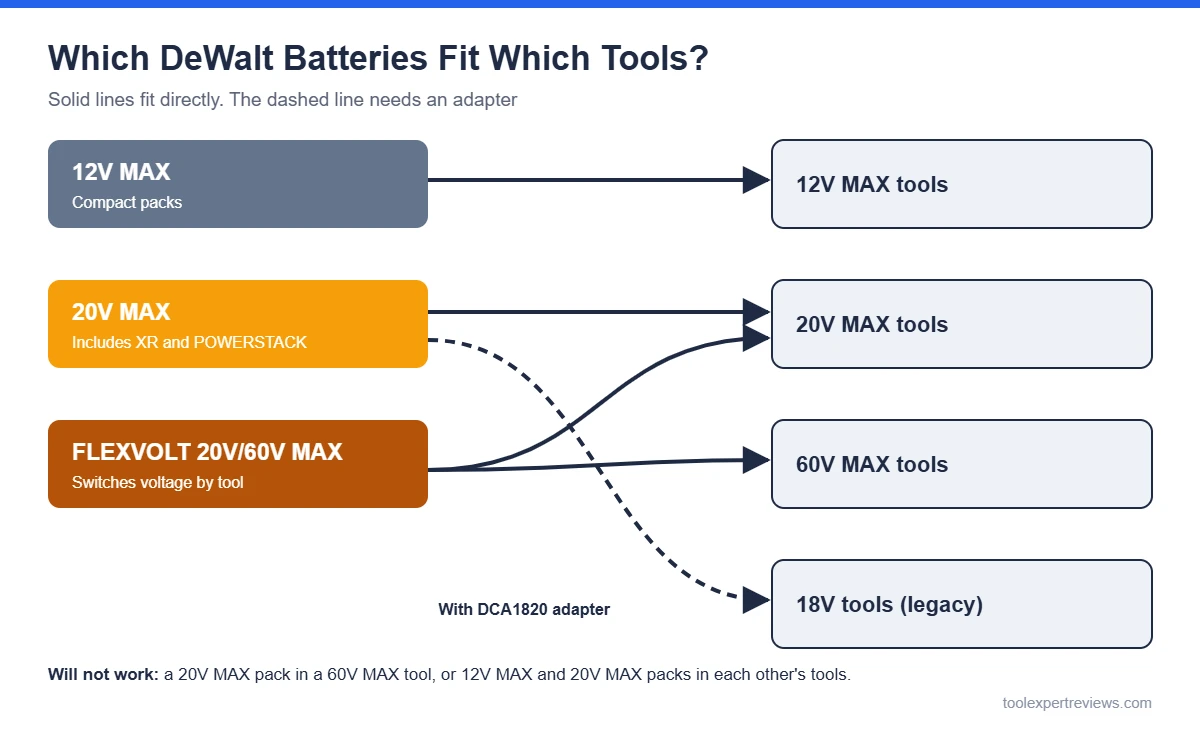
Quick answer: DeWalt has three main battery lines. 20V MAX is the current everyday platform, 18V is the older legacy system, and 60V MAX FlexVolt packs switch between 20V and 60V, so they also run 20V MAX tools. For drills and drivers, a 2.0 to 3.0Ah pack keeps the tool light; saws and grinders work better with 4.0Ah or more.
DeWalt Battery Types at a Glance
| Battery line | Voltage | Runs | Notes |
|---|---|---|---|
| 12V MAX | 12V max | 12V MAX tools | Small, light packs for compact drivers and lights |
| 20V MAX | 20V max (18V nominal) | 20V MAX tools | The main DeWalt platform today |
| 20V MAX XR | 20V max | 20V MAX tools | Higher capacity packs for saws and grinders |
| POWERSTACK | 20V max | 20V MAX tools | Pouch cell packs, shorter and lighter for their output |
| FLEXVOLT | 20V / 60V max | 20V MAX and 60V MAX tools | Switches voltage automatically to match the tool |
| 18V (legacy) | 18V | Older 18V tools | Older stem style; the DCA1820 adapter lets 20V MAX packs run 18V tools |
Whether you’re a weekend warrior tackling home improvements or a professional contractor running a job site, understanding DeWalt’s battery ecosystem can save you time, money, and frustration.
In this comprehensive guide, you’ll discover everything you need to know about DeWalt batteries, from the versatile 20V system to the powerhouse 60V FLEXVOLT technology.
DeWalt Batteries: Understanding the Ecosystem
DeWalt didn’t just create batteries, they engineered an entire power ecosystem. Since introducing their lithium-ion technology in 2010, DeWalt has shipped over 200 million battery packs worldwide, according to industry reports.
Revolutionary Lithium-Ion Technology
Your DeWalt battery uses advanced lithium-ion cells that deliver consistent power throughout the discharge cycle. Unlike older NiCad batteries that gradually lose power, lithium-ion maintains steady voltage until nearly depleted.
“The key breakthrough was developing cells that could handle the high current demands of power tools while maintaining safety and longevity,” explains battery technology expert Dr. Sarah Chen from Battery University.
The internal temperature management system prevents overheating during heavy use. When you’re driving screws continuously or cutting through dense materials, the battery automatically adjusts to protect the cells.
The 20V MAX Platform Advantage

DeWalt’s platform strategy means your battery investment grows with your tool collection. A single 20V battery can power over 200 different tools in their lineup.
This compatibility saves you significant money over time. Instead of buying tool-specific batteries, you can interchange them across your entire DeWalt collection.
Consider this scenario: You buy a drill/driver kit with two batteries.
Later, you add a circular saw, impact driver, and reciprocating saw.
Those same two batteries now power four tools instead of requiring eight separate battery purchases.
Performance Metrics That Drive Results
Understanding amp-hour (Ah) ratings helps you choose the right battery for your needs. Higher Ah ratings provide longer runtime but add weight and bulk.
Runtime scales roughly with amp hours: under the same load, a 5.0Ah pack runs about two and a half times as long as a 2.0Ah pack.
The voltage rating (20V, 60V) determines power output. Higher voltage delivers more torque and faster cutting speeds, especially important for demanding applications.
DeWalt 20V Battery: The Workhorse of Professional Tools
Your DeWalt 20V battery represents the sweet spot between power, weight, and runtime. This platform powers everything from compact drills to full-size circular saws.
Technical Specifications Breakdown

DeWalt offers 20V batteries in six capacity options: 1.5Ah, 2.0Ah, 3.0Ah, 4.0Ah, 5.0Ah, and 6.0Ah. Each serves different applications and runtime requirements.
The MAX designation indicates standard 20V batteries, while XR batteries feature enhanced cells with longer runtime and tool protection features.
XR batteries include internal electronics that communicate with compatible tools. That link is what makes features like electronic clutch protection and battery fuel gauges possible.
Temperature sensors prevent operation in extreme conditions. Your battery won’t charge below 32°F or above 105°F, protecting cell integrity and your safety.
DeWalt 20V Batteries: Choosing Your Capacity
Your tool selection should guide battery capacity choices. Compact tools like drill/drivers work efficiently with 2.0-3.0Ah batteries, maintaining good balance and reducing fatigue.
Larger tools benefit from higher capacity batteries. Circular saws, reciprocating saws, and grinders perform better with 4.0Ah or larger batteries.
The 6.0Ah battery weighs 1.4 pounds, 40% heavier than the 2.0Ah option. Consider whether the extended runtime justifies the additional weight for your applications.
Ready to upgrade your power tool game? Check current DeWalt 20V battery deals and starter kits here.
DeWalt Battery Charger: Powering Your Productivity
Your charging strategy directly impacts productivity and battery longevity. DeWalt offers multiple charger options designed for different user needs.
DeWalt Battery Charger Types

The standard DCB115 charger handles all 20V and 60V batteries, requiring 30 minutes for a 2.0Ah battery and 90 minutes for a 6.0Ah battery.
Fast chargers reduce these times significantly. The DCB118 charges a 2.0Ah battery in just 20 minutes, perfect for high-demand job sites where downtime costs money.
Multi-bay chargers accommodate multiple batteries simultaneously. DeWalt’s DCB1404 4 port charger charges four batteries at once, ideal for teams or users with extensive tool collections.
Vehicle chargers enable charging during transit. The DCB119 plugs into 12V outlets, ensuring batteries stay charged between job sites.
Smart Charging Technology
Your DeWalt charger monitors cell temperature throughout the charging process. If a battery becomes too warm, charging automatically pauses until temperature normalizes.
LED indicators communicate charging status clearly:
- Red light: Charging in progress
- Green light: Fully charged
- Red/green flashing: Battery too hot or cold
- Red flashing: Battery fault detected
The charger performs diagnostic checks during each charging cycle. It identifies weak cells and adjusts charging parameters to maximize battery life.
Charging Best Practices for Maximum Life
Charge batteries at room temperature when possible. Extreme temperatures stress cells and reduce lifespan.
You don’t need to fully discharge batteries before charging. Lithium-ion technology actually prefers partial discharge cycles over deep discharges.
Store batteries with 30-50% charge for long-term storage. This maintains cell chemistry balance during extended non-use periods.
“The biggest mistake people make is leaving batteries on chargers indefinitely,” warns battery expert Tom Wilson. “While modern chargers prevent overcharging, heat buildup during trickle charging can degrade cells over time.”
DeWalt 18V Battery: Legacy Power Still Going Strong
Your existing 18V tool collection doesn’t become obsolete with newer battery technologies. DeWalt continues supporting this platform while offering upgrade paths.
DeWalt 18V Battery System Overview
The 18V platform includes both NiCad and lithium-ion options. Lithium-ion 18V batteries offer significant advantages over older NiCad technology.
Lithium-ion 18V batteries weigh 40% less than equivalent NiCad batteries while providing 50% longer runtime. They also lack memory effect and self-discharge slowly.
Over 100 tools remain compatible with 18V batteries, from basic drills to specialized trade tools. This extensive compatibility protects your tool investment.
Transition Strategies from 18V to 20V

DeWalt offers adapter systems that allow 20V batteries to power 18V tools. The DCA1820 adapter enables this compatibility, though it adds bulk and weight.
For occasional 18V tool use, adapters provide a cost-effective solution. However, users with extensive 18V collections might benefit from dedicated 18V lithium-ion batteries.
Consider your usage patterns when deciding between adapters and dedicated batteries. Heavy daily use justifies dedicated batteries, while occasional use suits adapter solutions.
Looking to modernize your tool collection? Explore DeWalt 20V starter kits and upgrade options here.
DeWalt 60V Battery: FLEXVOLT Technology Revolution
DeWalt’s FLEXVOLT technology represents the biggest battery innovation since lithium-ion development. These intelligent batteries automatically switch between 20V and 60V operation.
DeWalt 60V Battery Innovation Explained
FLEXVOLT batteries contain 15 cells arranged in series/parallel configurations. When installed in 20V tools, cells connect in parallel for 20V operation. In 60V tools, they connect in series for 60V output.
This automatic switching happens instantly without user intervention. The battery detects tool requirements through communication pins in the battery interface.
“FLEXVOLT essentially gives you two batteries in one,” explains DeWalt’s engineering team. “It’s like having a transformer that automatically adjusts to power requirements.”
The 9.0Ah FLEXVOLT battery provides equivalent runtime to three 3.0Ah 20V batteries when used in 20V tools. This massive capacity eliminates frequent battery changes during extended work sessions.
High-Demand Applications
Your 60V battery excels in applications requiring sustained high power output. Table saws, miter saws, and large grinders benefit from the increased voltage and capacity.
FLEXVOLT batteries let DeWalt build high draw tools, like 60V MAX table saws, chainsaws and grinders, that would normally need a cord or gas engine.
For outdoor equipment, FLEXVOLT batteries power chainsaws, string trimmers, and blowers with runtimes approaching gas-powered alternatives. The 60V chainsaw provides 70+ cuts through 6×6 pressure-treated lumber on a single charge.
Professional Use Cases

Contractors report significant productivity gains with FLEXVOLT technology. Eliminating extension cords and generator requirements streamlines job site operations.
“We replaced our corded miter saw with the FLEXVOLT model and gained incredible flexibility,” reports contractor James Peterson. “Setup time dropped from 15 minutes to 2 minutes, and we can work anywhere on the job site.”
The return on investment becomes clear when considering time savings. Reduced setup, elimination of cord management, and freedom to work in any location add up to measurable productivity improvements.
FLEXVOLT batteries also serve as backup power sources. Many contractors use them to charge phones, power LED lights, and run small devices through DeWalt’s power station adapters.
Deciding between a 20V MAX pack and a FLEXVOLT pack? Our DeWalt 20V MAX vs FLEXVOLT comparison covers runtime, weight and which tools benefit. For a starter kit with batteries included, see the best cordless combo kits for homeowners.
Choosing the Right DeWalt Battery for Your Needs
Your battery selection should align with tool requirements, usage patterns, and budget considerations. Understanding these factors ensures optimal performance and value.
Application-Based Selection Guide

Light-duty applications (screwing, light drilling, LED lights) work efficiently with 1.5-3.0Ah batteries. These provide adequate runtime while minimizing weight and cost.
Medium-duty applications (general drilling, impact driving, small saws) benefit from 4.0-5.0Ah batteries. The increased capacity handles demanding tasks without excessive weight.
Heavy-duty applications (large saws, grinders, outdoor equipment) require 6.0Ah or FLEXVOLT batteries. These applications demand sustained high power output that smaller batteries cannot provide.
Consider your daily usage patterns. If you use tools continuously for 6+ hours daily, invest in higher capacity batteries and multiple chargers. Occasional users can optimize with smaller, less expensive options.
Battery Maintenance and Care
Store batteries in clean, dry environments at moderate temperatures. Extreme heat or cold accelerates degradation and can damage cells permanently.
Clean battery contacts regularly with a dry cloth. Dirt and debris can cause poor connections, reduced performance, and premature wear.
Monitor battery performance over time. Significantly reduced runtime or failure to hold charge indicates replacement needs. Most batteries provide 3-5 years of service under normal conditions.
Register your batteries for warranty coverage. DeWalt offers 3-year warranties on most lithium-ion batteries, providing protection against manufacturing defects.
“Proper care can extend battery life by 30-50%,” notes battery researcher Dr. Lisa Martinez. “Simple maintenance practices yield significant long-term savings.”
Ready to build your battery collection? Find the best DeWalt battery deals and bundles here.
Expert Buying Guide and Recommendations
These are our DeWalt battery picks by category, based on DeWalt’s published capacities and the tools each pack suits best.
Top DeWalt Battery Picks by Category

Best Overall: The 5.0Ah XR battery provides optimal balance of runtime, weight, and versatility. It powers all 20V tools effectively while maintaining reasonable size and weight.
Best Value: The 4.0Ah battery offers excellent runtime at a moderate price point. It handles most applications efficiently without premium battery costs.
Best for Heavy-Duty: FLEXVOLT 9.0Ah batteries excel in demanding applications. While heavier and more expensive, they provide unmatched runtime and power delivery.
Best Starter Option: The 2.0Ah battery included in most starter kits provides adequate performance for basic applications at the lowest cost.
Where to Buy and What to Avoid

Purchase from authorized dealers to ensure genuine products and warranty coverage. Home improvement stores, tool distributors, and verified online retailers offer legitimate products.
Beware of significantly discounted batteries from unknown sellers. Counterfeit batteries pose safety risks and lack warranty protection.
Verify seller credentials before purchasing online. Check reviews, return policies, and contact information. Legitimate sellers provide clear warranty information and customer support.
Consider seasonal sales and promotional bundles. Many retailers offer significant discounts during spring tool promotions and holiday sales events.
“I’ve seen counterfeit batteries that look identical to genuine DeWalt products,” warns tool retailer manager Sarah Thompson. “The only differences are slightly different fonts on labels and missing hologram security features.”
Future Outlook and Emerging Technologies
DeWalt continues investing in battery technology advancement. Solid-state batteries, currently in development, promise 50% weight reduction with increased energy density.
Wireless charging technology may eliminate physical charger connections within the next 5 years. DeWalt has filed patents for inductive charging systems integrated into tool storage solutions.
Fast-charging improvements target 80% capacity in 10 minutes or less. Current prototypes achieve this goal while maintaining battery longevity through advanced thermal management.
Integration with smart devices will provide detailed battery analytics. Future batteries may communicate performance data, maintenance schedules, and replacement recommendations through smartphone apps.
Related guides:
How Long Do DeWalt Batteries Last?
DeWalt Battery FAQ
Are DeWalt 20V and 60V batteries interchangeable?
Partly. A FLEXVOLT battery runs both 20V MAX and 60V MAX tools, but a standard 20V MAX pack cannot power a 60V MAX tool.
Do DeWalt 18V batteries fit 20V MAX tools?
No. The older 18V packs use a different stem style connection. The DCA1820 adapter works the other way, letting a 20V MAX battery run older 18V tools.
How do I find the positive and negative terminals on a DeWalt battery?
Use a multimeter set to DC volts and touch the probes to two terminals. A positive reading means the red probe is on the positive terminal, and a negative reading means the probes are reversed. Never short the terminals with metal.
Which DeWalt battery should I buy?
For drills and drivers, a 2.0 to 3.0Ah 20V MAX pack keeps the tool light. For saws, grinders and heated jackets on long days, a 5.0Ah pack or larger runs much longer.
Conclusion: Power Your Success with DeWalt Batteries
Your choice in battery technology directly impacts productivity, tool performance, and project outcomes. DeWalt’s comprehensive battery ecosystem provides solutions for every application and user level.
The 20V platform offers the perfect entry point with broad tool compatibility and reasonable costs. FLEXVOLT technology delivers professional-grade power for demanding applications. Even the legacy 18V system continues providing reliable service for existing tool collections.
Success comes from matching battery capabilities to your specific needs. Consider runtime requirements, tool compatibility, and long-term expansion plans when building your battery collection.
Quality batteries represent an investment in productivity and reliability. DeWalt’s proven track record, extensive warranty coverage, and continuous innovation make them a smart choice for professionals and enthusiasts alike.
Ready to experience the DeWalt difference? Shop the complete collection of DeWalt batteries and chargers here and power your next project with confidence.
Your tools are only as good as the batteries that power them. Choose wisely, maintain properly, and enjoy years of reliable cordless performance.
Related guides: