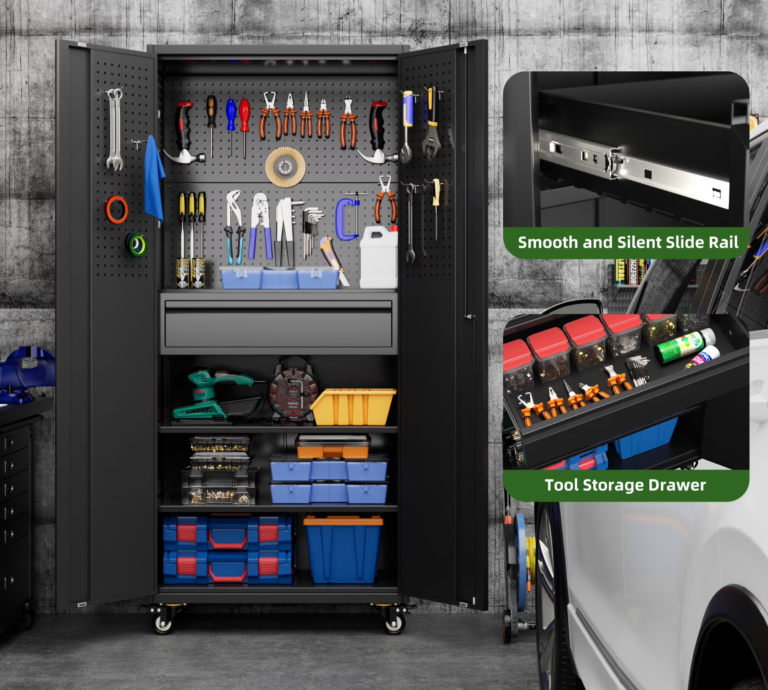
Best Rolling Tool Chest for Home and Jobsite: 7 Top Picks
The Short Verdict
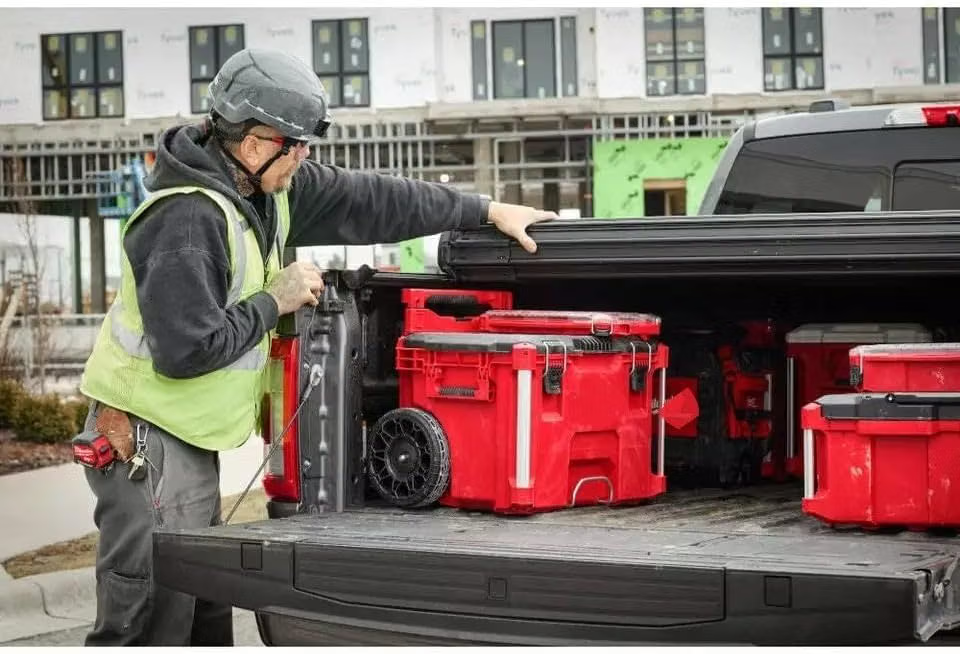
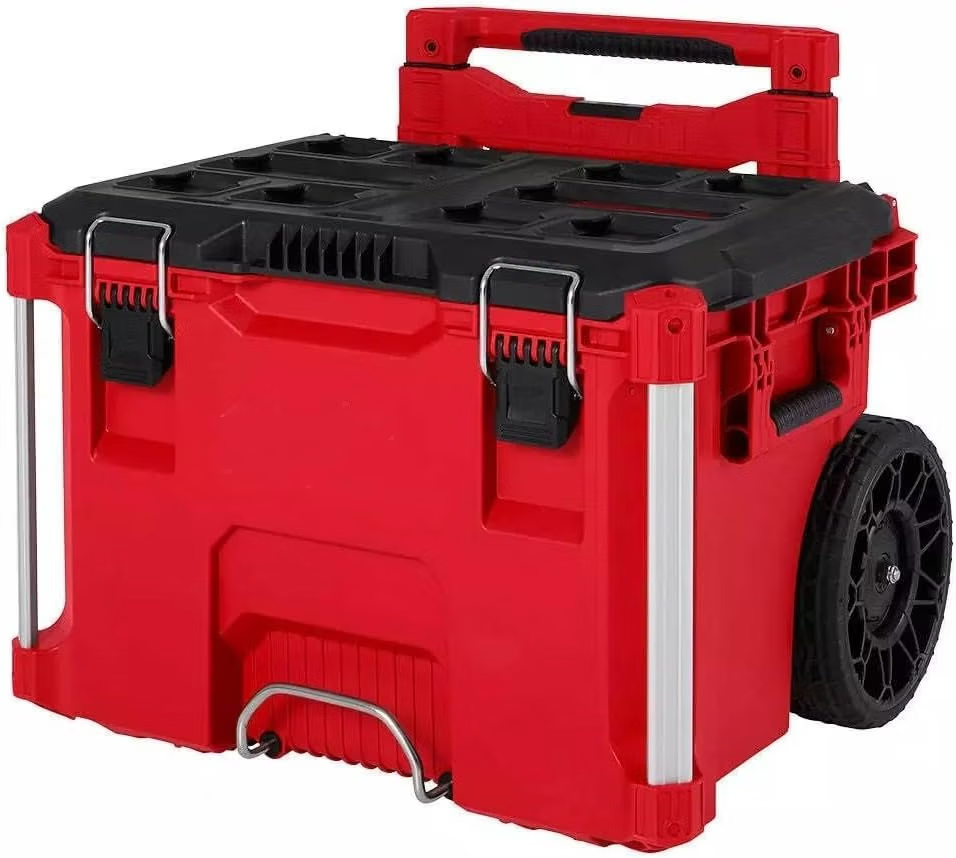
Best overall for the jobsite: Milwaukee PACKOUT Rolling Tool Box. It carries a heavy load over broken ground and locks into a stacking system you can grow one box at a time.
Best overall for the home garage: Craftsman 2000 Series 26 in. 5-Drawer Rolling Tool Cabinet. Ball-bearing slides, a usable footprint, and drawer depth that suits a mixed hand and power tool kit.
Best on a tight budget: Torin Big Red Rolling Tool Cart. Basic steel, honest capacity, and enough organisation to stop the floor-pile habit.
A rolling tool chest for home and jobsite work has to solve two different problems with one box. In the garage it needs drawer depth, a stable footprint, and slides that still run smoothly after five years. On site it needs wheels that survive gravel, latches that hold through a truck bed, and a lock that means something.
Most buyers get burned because they shop on drawer count alone. Drawer count tells you almost nothing about load rating, caster quality, or steel gauge, and those three things decide whether the chest lasts a decade or sags in a season.
This guide breaks down the seven models worth your attention, the specifications that actually predict durability, and the mistakes that cost people money. Selections are based on published manufacturer specifications, sustained trade use patterns, and long-run owner feedback rather than a single afternoon of handling.
This post contains affiliate links. We earn a commission when you purchase through our links at no extra cost to you. We only recommend products we’ve personally tested and use ourselves.
Why Tool Storage Is a Safety and Money Decision
Lifting is the single most expensive injury category in American workplaces. Bureau of Labor Statistics data shows that overexertion, repetitive motion and bodily conditions accounted for roughly 946,290 DART cases across 2023 and 2024, the largest of any category. Back-related cases alone accounted for about 248,180 days away from work in 2024.
The cost side is just as blunt. The Liberty Mutual Workplace Safety Index puts overexertion involving outside sources at the top of the table at roughly 13.7 billion dollars a year, a position it has held for more than two decades. Rolling a 200 pound load instead of carrying it in three trips is not a convenience upgrade, it is a risk control.
Treat storage as safety equipment and the spending decision gets easier. A well-specified rolling tool chest for home and jobsite work belongs in the same category as your work boots and hearing protection.
Theft is the second money argument. The National Equipment Register and the National Insurance Crime Bureau estimate that construction site theft costs between 300 million and 1 billion dollars a year in the United States, with recovery rates under 25 percent for heavy equipment and far lower for hand tools. A lockable chest that bolts or chains down will not stop a determined crew, but it removes you from the easy-target list.
Demand reflects all of this. The global tool storage products market was valued at about 1.71 billion dollars in 2023 and is forecast to reach roughly 2.31 billion by 2029, a compound annual growth rate near 5.1 percent, with tool carts and trolleys among the fastest-moving segments.
How to Choose a Rolling Tool Chest
1. Load Rating Beats Drawer Count
Check the stated total load capacity and the per-drawer rating separately. A chest advertising nine drawers with a 30 pound per-drawer limit holds less usable weight than a five-drawer unit rated at 100 pounds each.
For a home garage with hand tools and a few cordless kits, a 400 to 600 pound total rating is comfortable. Jobsite boxes carrying impact wrenches, sockets, and consumables should be rated at 250 pounds or more on the wheels alone.
2. Casters Decide Where It Can Actually Go
Garage chests usually ship with 2 to 3 inch polyurethane or rubber casters, which are fine on concrete and useless on gravel. Jobsite boxes need 7 inch or larger wheels with a sealed bearing or a solid rubber tyre to clear kerbs, thresholds, and rubble.
Look for two locking casters at minimum. A chest that creeps while you pull a drawer is a tipping hazard, especially when the top drawers are loaded and the bottom ones are empty.
3. Steel Gauge and Resin Quality
With steel, lower gauge numbers mean thicker metal. Budget chests often use 22 to 24 gauge bodies, mid-range units sit around 19 to 21 gauge, and professional cabinets use 18 gauge or heavier where it counts.
Impact-resistant resin has closed much of the gap for site work. Polypropylene and structural foam boxes shrug off rain and road salt in a way painted steel does not, which matters if the box lives in an open truck bed.
4. Slides, Latches, and Locks
Ball-bearing slides are the standard to insist on for drawers. Friction slides bind under load and are the most common reason a cheap chest feels worn out after one season.
For security, a single central locking bar across all drawers is more useful than individual drawer locks. Add a hasp or a chain point if the chest will sit unattended overnight.
5. Modularity and Work Surface
Modular systems let you buy the rolling base now and add stacking boxes as your kit grows. That flexibility is worth a premium if you run multiple trades or change site setups often.
A flat, load-rated top turns the chest into a staging bench. Stainless or hardwood tops handle solvents and heat better than powder-coated steel, which chips and then rusts at the chip.
Specification Comparison at a Glance
| Model | Best For | Body | Storage Format | Wheels |
|---|---|---|---|---|
| Milwaukee PACKOUT Rolling Tool Box | Jobsite | Impact resin | Deep bin, stackable | 9 in. all-terrain |
| DEWALT ToughSystem 2.0 Rolling | Jobsite modular | Structural resin | Bin plus stack | 7 in. rubber |
| Craftsman 2000 Series 26 in. | Home garage | Powder-coated steel | 5 drawers | Swivel casters |
| Viper Tool Storage 26 in. 5-Drawer | Premium home shop | Steel, stainless top | 5 drawers | Locking casters |
| Seville Classics UltraHD Workbench | Bench hybrid | Steel, wood top | Drawers plus cabinet | Heavy casters |
| Keter Masterloader | Weather exposure | Polypropylene | Bin plus trays | Telescoping handle |
| Torin Big Red Rolling Tool Cart | Budget | Light steel | 4 to 5 drawers | Standard casters |
The 7 Best Rolling Tool Chests Reviewed
1. Milwaukee PACKOUT Rolling Tool Box: Best Overall for the Jobsite
The PACKOUT rolling base is the benchmark for site storage because it solves transport first. The oversized all-terrain wheels and reinforced telescoping handle move a heavily loaded stack across gravel, mud, and kerbs without the wheel flex that ruins smaller carts.
Everything above it clips into the same cleat system, so you can start with the rolling box and add organisers and crates as the kit grows. The impact-resistant polymer body and IP-rated seal handle rain and dust that would pit a painted steel chest inside a season.
The trade-off is drawer organisation. This is a deep bin with removable trays, not a drawer cabinet, so fine sorting depends on the organisers you stack on top.
Pros: Best-in-class wheels, deep waterproof seal, huge accessory ecosystem, locks as one unit.
Cons: Premium pricing, bin storage rather than drawers, heavy when fully stacked.
Verdict score: 9.4 / 10. The safest long-term buy if your tools travel.
2. DEWALT ToughSystem 2.0 Rolling Tool Box: Best Modular Alternative
ToughSystem 2.0 uses a side-latch design that lets you remove a middle box without unstacking the whole tower. On a site where you swap kits between tasks, that single feature saves real time every day.
The 7 inch rubber wheels and metal-reinforced handle handle uneven ground well, though not quite to PACKOUT standard on loose gravel. The boxes themselves are watertight enough for open truck beds and outdoor storage.
Pair it with a reliable cordless platform and the system pays off. If you are still choosing a battery family, our DeWalt cordless drill review covers how the ecosystems compare.
Pros: Remove any box from the stack, watertight seals, strong handle, wide accessory range.
Cons: Smaller wheels than PACKOUT, latches need occasional cleaning on dusty sites.
Verdict score: 9.0 / 10. The best pick if you reconfigure your kit often.
3. Craftsman 2000 Series 26 in. 5-Drawer Rolling Cabinet: Best for the Home Garage
This is the sweet spot for most home shops. The 26 inch width fits a standard single-car garage bay without eating walking space, and the five drawers give you enough separation for sockets, wrenches, drivers, and consumables.
Ball-bearing slides are the reason this unit outlives cheaper cabinets. Drawers stay square under load, and the internal locking bar secures everything with one key turn.
Steel gauge is mid-range rather than professional, so avoid parking heavy engine components on the top. Treat it as a storage cabinet with a staging surface and it will serve for years.
Pros: Smooth ball-bearing slides, central locking bar, sensible footprint, strong parts availability.
Cons: Small casters limit it to smooth floors, top surface chips if abused.
Verdict score: 8.9 / 10. The default answer for a garage tool chest.
4. Viper Tool Storage 26 in. 5-Drawer Rolling Cabinet: Best Premium Home Shop Option
Viper builds to a heavier standard than most cabinets in this size class, with a stainless work top that resists solvents, heat, and the chipping that plagues powder coat. The drawers run on full-extension ball-bearing slides, so the back of the drawer is actually reachable.
Load ratings per drawer are higher than the mainstream competition, which matters if you store socket sets and impact accessories rather than screwdrivers. Locking casters are fitted as standard rather than as an upgrade.
It costs meaningfully more than a mid-range cabinet. If you are equipping a shop you intend to keep, the cost spread over a decade is small.
Pros: Stainless top, full-extension slides, higher per-drawer load rating, locking casters included.
Cons: Higher price, heavier to reposition, colour options vary by stock.
Verdict score: 8.7 / 10. Buy once if the shop is permanent.
5. Seville Classics UltraHD Rolling Workbench: Best Chest and Bench Hybrid
If your garage has room for one unit only, this hybrid does double duty. You get a solid hardwood work surface rated for real bench work, plus drawer and cabinet storage underneath on heavy-duty casters.
The steel frame is noticeably more rigid than a standard cabinet because it is engineered to take downward working force. Clamping a vice to the top is realistic here in a way it is not on a thin powder-coated lid.
Drawer count is lower than a dedicated chest, so plan to pair it with a wall system or a small top box. Our project tool checklist helps you work out what actually needs drawer space.
Pros: Genuine work surface, rigid frame, heavy casters, good value per square foot.
Cons: Fewer drawers, wood top needs sealing, assembly takes time.
Verdict score: 8.5 / 10. Best answer for a single-unit garage.
6. Keter Masterloader Rolling Tool Box: Best for Weather Exposure
Steel rusts, and polypropylene does not. For anyone whose box lives in an open truck bed, a trailer, or an unheated shed, that single fact outweighs a lot of premium features.
The Masterloader combines a deep lower bin, a removable organiser, and a folding front section that opens without unloading the top. Weight is low enough to lift into a vehicle alone, which is not true of most steel chests.
Rigidity is the compromise. Overload it with heavy steel and the body flexes, so keep the dense items low and central.
Pros: Rust-proof, light enough to lift solo, clever front-access design, affordable.
Cons: Flexes under heavy loads, plastic latches are the weak point, basic security.
Verdict score: 8.0 / 10. The practical pick for wet climates.
7. Torin Big Red Rolling Tool Cart: Best Budget Rolling Chest
This is the entry point that still counts as a real tool chest rather than a toy. You get a steel body, multiple drawers with liners, and a locking mechanism for a fraction of the cost of a branded cabinet.
Expect lighter gauge steel and simpler slides than the mid-range options above. Loaded sensibly with hand tools and fasteners rather than heavy iron, it does the organisational job well.
For a first garage, a second satellite chest, or a hobby bench, it is hard to argue with. Keep your cutting and striking tools protected with decent work gloves while you are loading it out.
Pros: Very affordable, steel construction, drawer liners included, compact footprint.
Cons: Thin gauge, basic slides, lock is deterrent-level only.
Verdict score: 7.6 / 10. Strong value if expectations match the price.
Scored Summary
Here is how each rolling tool chest for home and jobsite use scored across build quality, mobility, storage layout, security, and value. Scores weight durability and wheel performance most heavily, because those are the two failure points owners report first.
| Rank | Model | Award | Score |
|---|---|---|---|
| 1 | Milwaukee PACKOUT Rolling Tool Box | Best overall jobsite | 9.4 |
| 2 | DEWALT ToughSystem 2.0 Rolling | Best modular | 9.0 |
| 3 | Craftsman 2000 Series 26 in. | Best home garage | 8.9 |
| 4 | Viper Tool Storage 26 in. | Best premium | 8.7 |
| 5 | Seville Classics UltraHD Workbench | Best hybrid | 8.5 |
| 6 | Keter Masterloader | Best weather-resistant | 8.0 |
| 7 | Torin Big Red Rolling Tool Cart | Best budget | 7.6 |
Frequently Asked Questions
What size rolling tool chest do I need for a home garage?
A 26 inch, five-drawer cabinet suits most home users with a mixed hand and cordless tool kit. Step up to 41 inches only if you own multiple socket sets, specialty automotive tools, or a full pneumatic kit.
Is a rolling tool chest worth it on a jobsite?
Yes, provided the wheels match the ground. Large rubber or all-terrain wheels are essential, because small garage casters jam on gravel and turn a rolling load back into a carried load.
Steel or plastic: which lasts longer?
Steel wins for rigidity and load capacity in a dry indoor space. Impact-resistant polymer wins outdoors, in truck beds, and anywhere moisture and road salt are present, because it cannot rust through.
How do I stop a loaded tool chest from tipping?
Load the heaviest items in the bottom drawers and keep the top ones light. Engage the locking casters before opening any drawer, and never open two full drawers at once.
Can I secure a rolling tool chest against theft?
A central locking bar plus a chain or cable through the frame to a fixed anchor deters opportunistic theft. Given recovery rates for stolen hand tools, an engraved asset mark and a photographed inventory are worth the hour they take.
Final Recommendation
If your tools travel, the Milwaukee PACKOUT Rolling Tool Box is the one to buy, because the wheels and the stacking system solve problems no drawer cabinet can. If your tools stay home, the Craftsman 2000 Series gives you the slides and the drawer depth that keep a garage organised for the long term.
Still weighing options? Run two models through our side-by-side tool comparison or start with the tool finder quiz.
Also Read On: >>>Best Dust Collector for One Car Garage Shops in 2026
>>>Best Garage Heaters for a Cold Workshop
>>>Milwaukee vs DeWalt vs Ryobi: Which Cordless Tool Platform Wins in 2026?