Best Pressure Washers for Home and Driveway: 5 Picks for 2026

This post contains affiliate links. We earn a commission when you purchase through our links at no extra cost to you.
Our best overall driveway pressure washer. Rated at 3,000 PSI and up to 2.0 GPM, it is the closest an outlet-powered washer gets to gas performance.
Check Price on Amazon →🔌 Is your cord thick enough? Enter your tool amps and cord length in the extension cord gauge calculator.
Quick Verdict
The best pressure washers for home and driveway cleaning balance pressure, water flow, and ease of use. For most homeowners, the Greenworks GPW3001 is the one to buy. It delivers gas level cleaning from a standard wall outlet.
- Best overall: Greenworks GPW3001 (3,000 PSI electric)
- Most powerful electric: Westinghouse WPX3400e (3,400 max PSI, 2.0 max GPM)
- Best compact: Westinghouse ePX3100v (under 18 pounds)
- Best for beginners: Craftsman CMEPW2100
- Best budget and car washing: Sun Joe SPX3000
A dirty driveway can make a clean house look tired. The right machine fixes that in an afternoon, but the wrong one either stalls on oil stains or strips paint off your siding. This guide explains what to buy and why.
We compared manufacturer specifications, published independent test results, and long term owner feedback. We did not bench test these units ourselves,. Where a number comes from an outside source, we link to it.
Pressure Washer Numbers Worth Knowing
5 to 10 GPMTypical flow from an open garden hose
1.2 to 2.5 GPMTypical flow from a home pressure washer
Up to 80%Less water per cleaning task, per Karcher
6,000+Estimated yearly US emergency room visits
A garden hose releases roughly 5 to 10 gallons per minute, while residential pressure washers use about 1.2 to 2.5. Karcher calculates that a pressure washer can use up to 80 percent less water for the same job. The saving comes from lower flow and a shorter cleaning time.
The power also carries risk. Consumer Product Safety Commission figures cited in a University of California safety note show about 3,100 people were treated in hospitals for pressure washer injuries in 2003. Later CPSC estimates passed 6,000 emergency room visits in a single year, with almost 15 percent needing hospitalization.
How to Choose the Best Pressure Washers for Home and Driveway Use
PSI and GPM: The Two Numbers That Matter
PSI is pressure, which breaks the bond between dirt and the surface. GPM is flow, which rinses that dirt away. A machine with high PSI but weak flow cleans slowly, so always read both numbers together.
Be careful with “max” ratings. Many electric models list a maximum PSI and a maximum GPM that are not delivered at the same moment. Look for PWMA certified ratings where you can, because those figures are independently verified.
How Much Pressure Do You Need?
| Job | Suggested PSI | Best nozzle |
|---|---|---|
| Cars, bikes, patio furniture | 1,200 to 1,900 | 40 degree or soap |
| Vinyl siding, wood decks, fences | 1,500 to 2,500 | 25 or 40 degree |
| Concrete driveways and sidewalks | 2,500 to 3,200 | 15 or 25 degree, or turbo |
| Oil stains and paint prep | 3,000 and above | 15 degree or turbo |
Electric vs Gas
Electric models are quieter, lighter, and almost maintenance free. In Bob Vila’s 45 hour test of 13 machines, most electric units measured around 70 decibels. That is close to the sound of a household vacuum.
Gas models deliver more flow, so they clean large slabs faster. They also need oil, fuel, and winter storage care. Choose gas only if you have a long driveway or no outlet within reach.
A Note on Power
Most electric pressure washers draw 13 to 14.5 amps. That is close to the limit of a standard 15 amp household circuit, so run the washer on its own outlet. Plug directly into a GFCI protected receptacle and avoid light duty extension cords.
If you are unsure whether an outdoor outlet is live and correctly wired, test it first. Our guide to the best voltage testers covers reliable options. You can also weigh models against each other with our side by side tool comparison.
On a tight budget or living in an apartment? Our guide to the best pressure washers under $300 covers compact models that store in a closet.
Specs Comparison Table
| Model | Power | PSI | GPM | Hose | Best for |
|---|---|---|---|---|---|
| Greenworks GPW3001 | Electric | 3,000 | Up to 2.0 | 25 ft | Most homes |
| Westinghouse WPX3400e | Electric, brushless | 3,400 max | 2.0 max | 25 ft | Large driveways |
| Westinghouse ePX3100v | Electric | 2,100 max | 1.76 max | 25 ft | Small spaces |
| Craftsman CMEPW2100 | Electric | 2,100 | 1.2 | 25 ft | Beginners |
| Sun Joe SPX3000 | Electric | 2,030 | 1.2 | 20 ft | Cars and budgets |
The 5 Best Pressure Washers Reviewed
Best Overall
1. Greenworks GPW3001 Electric Pressure Washer
The Greenworks GPW3001 is the closest an outlet powered machine gets to gas performance. It is rated at 3,000 PSI with flow of up to 2.0 GPM, and it uses a brushless motor. Bob Vila’s testers found it cleaned concrete nearly twice as fast as the next best electric model.
| Pressure | 3,000 PSI (PWMA certified) |
| Flow | Up to 2.0 GPM |
| Hose | 25 ft, flexible |
| Nozzles | Five quick connect tips plus soap cannon |
| Wheels | 10 inch, steel frame |
The steel wheelbarrow style frame keeps the weight low, and the unit stores upright against a garage wall. It is easy to pull but awkward to push and steer. It also sits at the premium end of electric pricing.
Pros
- Gas like power from a wall outlet
- Independently verified pressure rating
- Quiet brushless motor
- Stores vertically
Cons
- Costs more than basic electric units
- Clumsy when pushed
- Heavier than compact models
Verdict: The best choice for concrete driveways without gas upkeep.
Most Powerful Electric
2. Westinghouse WPX3400e Electric Pressure Washer
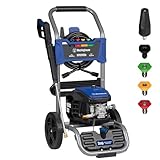
If you have a long or badly stained driveway but do not want gas upkeep, the WPX3400e is the strongest electric pick here. Westinghouse rates it at 3,400 max PSI and 2.0 max GPM at the lowest pressure, with 3,000 rated PSI and 1.1 rated GPM, from a brushless 120V motor.
| Pressure | 3,400 max PSI, 3,000 rated |
| Flow | 2.0 max GPM, 1.1 rated |
| Motor | 120V brushless with auto-stop pump |
| Hose and cord | 25 ft hose, 35 ft GFCI cord |
| Extras | Five quick connect nozzles, onboard soap tank, 10 inch never flat wheels |
Westinghouse lists a weight of about 42 pounds and a three year limited warranty. The steel frame and large wheels make it easy to roll down a driveway, and it works with surface cleaner attachments for faster slab cleaning.
Pros
- Highest pressure rating in this list
- No gas, oil or pull starts
- Long 35 ft GFCI cord
Cons
- Heavier than compact electric models
- Rated flow is lower than gas washers
The best choice for big driveways when you want gas level pressure from an outlet.
Best Compact
3. Westinghouse ePX3100v Electric Pressure Washer

The ePX3100v is shaped like a small toolbox and weighs just under 18 pounds. Even so, it is rated at 2,100 max PSI and 1.76 max GPM. It suits townhouses, small driveways, and anyone short on storage.
| Pressure | 2,100 max PSI |
| Flow | 1.76 max GPM |
| Weight | Under 18 lb |
| Hose and cord | 25 ft hose, 35 ft cord |
| Extras | Foam cannon, steel wand, turbo nozzle |
The trade off is convenience on the move. There are no wheels, so you carry it between spots. There is also no onboard storage for the hose or cord.
Pros
- Light and easy to store
- Turbo nozzle helps on concrete
- Foam cannon included
- Friendly price
Cons
- No wheels
- No hose or cord storage
- Slow on large driveways
Verdict: Big cleaning ability in a very small package.
Best for Beginners
4. Craftsman CMEPW2100 Electric Pressure Washer

First time buyers want a machine that sets up fast and stays upright. The Craftsman CMEPW2100 has oversized 10 inch wheels, a tip resistant frame, and storage for every accessory. Its 2,100 PSI and 1.2 GPM are gentle enough for cars, decks, and fences.
| Pressure | 2,100 PSI |
| Flow | 1.2 GPM |
| Hose and cord | 25 ft hose, 35 ft cord |
| Nozzles | 15, 25, 40 degree, soap, turbo |
| Extras | Built in soap tank, onboard storage |
Independent testers noted that it runs at about 70 decibels without the high pitched whine common to this class. The lower flow means deep concrete stains take patience. Use the turbo nozzle for driveway work.
Pros
- Simple setup and storage
- Stable on uneven ground
- Pleasant motor tone
- Automatic soap draw
Cons
- Hose kinks when new
- Limited on stubborn concrete stains
- Lower flow than rivals
Verdict: The easiest machine here to live with.
Best Budget and Car Washing
5. Sun Joe SPX3000 Electric Pressure Washer

The Sun Joe SPX3000 has been a best seller for years for a simple reason. It offers 2,030 PSI, 1.2 GPM, and five spray tips at an entry level price. Dual 0.9 liter detergent tanks let you switch between two soaps.
| Pressure | 2,030 max PSI |
| Flow | 1.2 GPM |
| Hose and cord | 20 ft hose, 35 ft cord |
| Nozzles | 0, 15, 25, 40 degree, soap |
| Extras | Two detergent tanks, 34 inch wand |
It is ideal for cars, mowers, and patio furniture. The 20 foot hose is the shortest in this guide, and the plastic fittings feel basic. For a small driveway cleaned once or twice a year, it still does the job.
Pros
- Low cost of entry
- Two soap tanks
- Five nozzles included
- Easy to wheel around
Cons
- Shortest hose here
- Basic plastic fittings
- Slow on heavy concrete grime
Verdict: Hard to beat for light duty value.
Safety Gear You Should Not Skip
Pressure washers produce 1,000 to 4,000 PSI at the wand, which is enough to inject water through skin. Never point the wand at people or pets, and never use a gas model in a garage. Carbon monoxide builds up quickly in enclosed spaces.
Wear anti fog safety glasses, work gloves, and closed work boots with good grip. Wet concrete is slippery, and flying grit is common.
Planning a full exterior refresh? Our project tool checklist lists everything else you may need.
Only cleaning cars, bikes and patio furniture? A lighter battery model may be all you need. Compare the best cordless pressure washers.
Electric pressure washers need the right cord. See what size extension cord you need.
Putting it away for winter? Follow our pressure washer winterizing checklist so the pump does not crack in the cold.
Frequently Asked Questions
What is a ceramic pressure washer, and is it worth it?
A ceramic pressure washer has ceramic coated pistons in its pump. Ceramic resists wear better than bare metal, so the pump keeps its pressure longer, which matters if you wash a driveway, deck or siding often. Look for “ceramic pistons” on the spec sheet, and pair the pump with the PSI and GPM your job needs.
What PSI is best for cleaning a concrete driveway?
Aim for 2,500 to 3,200 PSI. Machines around 2,000 PSI can still clean concrete with a turbo nozzle, but the work takes longer. Flow of 2.0 GPM or more speeds things up noticeably.
Is an electric pressure washer strong enough for a driveway?
Yes, for most homes. A 3,000 PSI electric model such as the Greenworks GPW3001 handles typical dirt, algae, and tire marks. Very large or oil soaked driveways are still better suited to gas.
Can a pressure washer damage concrete or siding?
It can. A zero degree nozzle held close will etch concrete and cut into wood or vinyl. Start with a 25 or 40 degree tip, hold it about 12 inches away, and test a hidden spot first.
How much water does a pressure washer use?
Home models use about 1.2 to 2.5 gallons per minute. An open garden hose flows at roughly 5 to 10 gallons per minute. Because the job also finishes sooner, total water use is usually much lower.
How often should I pressure wash my driveway?
Once a year is enough for most driveways. Shaded or damp areas that grow algae may need a second pass in the fall. Sealing the concrete afterward keeps it clean for longer.
Our Final Recommendation
For most people shopping for the best pressure washers for home and driveway jobs, the Greenworks GPW3001 is the smart buy. It has the power for concrete and none of the upkeep of gas.See the Greenworks GPW3001 on Amazon
Still deciding? Take the tool finder quiz for a personal match.
Also Read On:
>>>Best Work Gloves for Storm Cleanup and Fuel Handling (2026 Guide)
>>>Best Rechargeable LED Work Lights for Garages and Jobsites (2026)
>>>How to Choose Insulated Screwdrivers for Panel and Transfer Switch Work
Related guides: