Best Clamp Meter for Electricians in 2026: 5 Pro Picks Rated by an Engineer
Finding the best clamp meter for electricians comes down to three things: a safety rating that matches the panel in front of you, True-RMS accuracy on modern loads, and jaws that fit where the conductors actually sit. I’m Moses Washika, a licensed electrical engineer, and I narrowed this list to five meters that cover residential service calls, commercial fit-outs, and heavy industrial work.
The stakes are real. According to Electrical Safety Foundation International (ESFI) analysis of BLS data, 2,070 workplace deaths involved electricity between 2011 and 2024, which works out to roughly 150 every year. A meter you can trust is part of your first line of defense before your hands go anywhere near a live conductor.
This post contains affiliate links. We earn a commission when you purchase through our links at no extra cost to you. We only recommend products we’ve personally tested and use ourselves.
Quick Verdict: Our Top Picks
- Best Overall: Klein Tools CL800 for CAT IV 600V protection, AC/DC amps, and LoZ mode at a mid-range price.
- Best for Industrial Work: Fluke 376 FC for 1000A jaws, 2500A iFlex reach, and wireless logging.
- Best for Residential Electricians: Fluke 323 for a slim, no-fuss meter built for panels and service calls.
- Best Jobsite Build: Milwaukee 2237-20 for its thin jaw, LED work light, and five-year warranty.
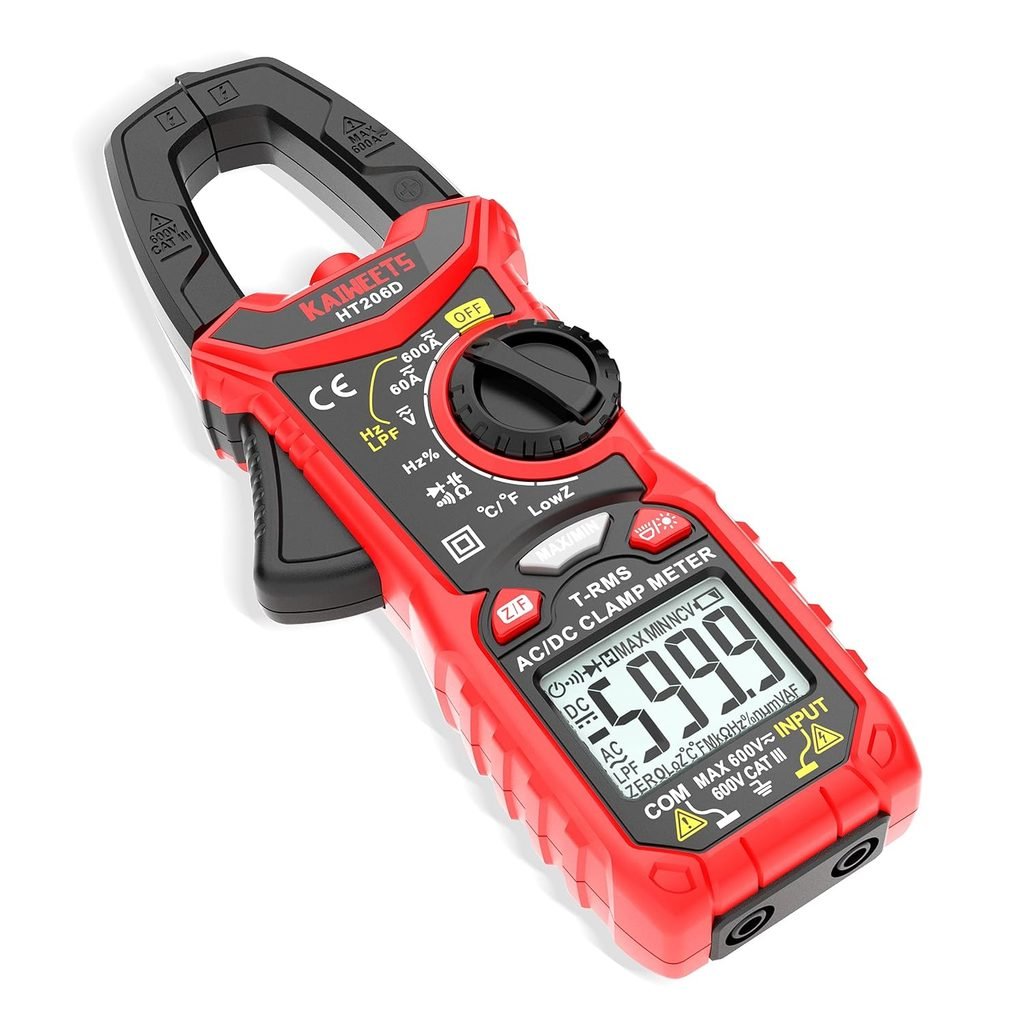
- Best Budget Pick: KAIWEETS HT206D for apprentices who want LoZ and DC amps without a big spend.
Why the Right Clamp Meter Matters More Than Ever
Demand for electricians keeps climbing. The Bureau of Labor Statistics reports that electricians held about 818,700 jobs in 2024, with employment projected to grow 9 percent from 2024 to 2034. That is much faster than the average for all occupations, and it adds up to about 81,000 openings every year.
818,700U.S. electrician jobs in 2024 (BLS)
9%Projected job growth, 2024 to 2034 (BLS)
~150Workplace electrical deaths per year (ESFI)
5,180Electrical injuries with days away from work, 2023 to 2024 (ESFI)
Safety data tells the other half of the story. ESFI counted 5,180 nonfatal electrical injuries that caused days away from work across 2023 and 2024, and electricians rank among the five occupations that account for nearly half of all workplace electrical fatalities. A properly rated meter will not prevent every accident, but an underrated one can turn a routine reading into an arc flash.
How to Choose a Clamp Meter: Buying Guide
1. Match the CAT Safety Rating to Your Work
Measurement categories under IEC 61010 describe how much transient energy a meter can survive. CAT II covers plug-in loads, CAT III covers distribution panels, feeders, and fixed equipment, and CAT IV covers the service entrance, meter base, and utility side. If you ever work upstream of the main breaker, buy a meter rated CAT IV.
Within a category, the higher voltage number is the stronger rating. Look for independent certification from UL, CSA, or ETL rather than a rating printed only on the box.
2. Insist on True-RMS
LED drivers, variable frequency drives, and switching power supplies distort the sine wave. Average-responding meters can misread these loads badly, which leads to wrong breaker sizing and missed overloads. Every meter on this list is True-RMS.
3. Decide Between AC Only and AC/DC Current
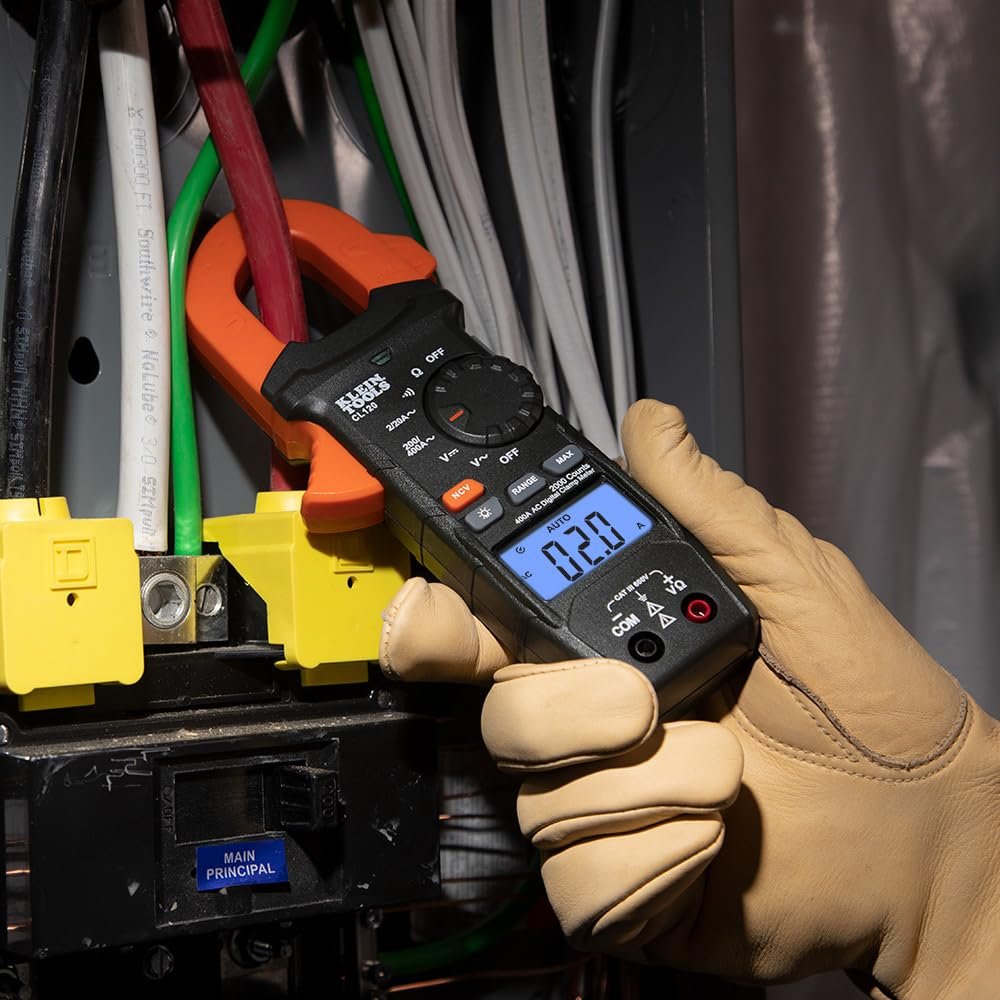
An AC-only clamp handles most residential troubleshooting. If you work on solar PV, battery banks, EV chargers, or DC motors, you need a Hall-effect AC/DC clamp that reads DC amps without breaking the circuit.
4. Check the Current Range and Jaw Opening
A 400A meter covers typical 200A residential services. Commercial work usually calls for 600A, while industrial switchgear and large feeders push you toward 1000A or a flexible iFlex style probe. Jaw size matters just as much, because a meter is useless if it will not close around the conductor.
5. Look for Time-Saving Features
Low impedance (LoZ) mode bleeds off ghost voltage so you do not chase phantom readings. Inrush capture shows true motor starting current, and a low pass filter steadies readings on VFD outputs. Non-contact voltage detection, a backlight, and a work light make dark panels far easier to read.
Clamp Meter Comparison Table
| Model | Max Current (Jaw) | Current Type | Max Voltage | Safety Rating | Standout Feature |
|---|---|---|---|---|---|
| Klein Tools CL800 | 600A | AC/DC | 1000V AC/DC | CAT IV 600V, CAT III 1000V | LoZ mode, temperature probe |
| Fluke 376 FC | 1000A (2500A AC with iFlex) | AC/DC | 1000V AC/DC | CAT IV 600V, CAT III 1000V | Inrush, Fluke Connect wireless |
| Fluke 323 | 400A | AC only | 600V AC/DC | CAT IV 300V, CAT III 600V | Slim body for tight panels |
| Milwaukee 2237-20 | 600A | AC/DC | 600V AC/DC | CAT III 600V | LED work light, built-in NCV |
| KAIWEETS HT206D | 600A | AC/DC | 600V AC/DC | CAT III 600V | LoZ, LPF, and NCV on a budget |
Want to line these up against other testers? Try our side-by-side tool comparison.
The 5 Best Clamp Meters for Electricians, Reviewed
Best Overall
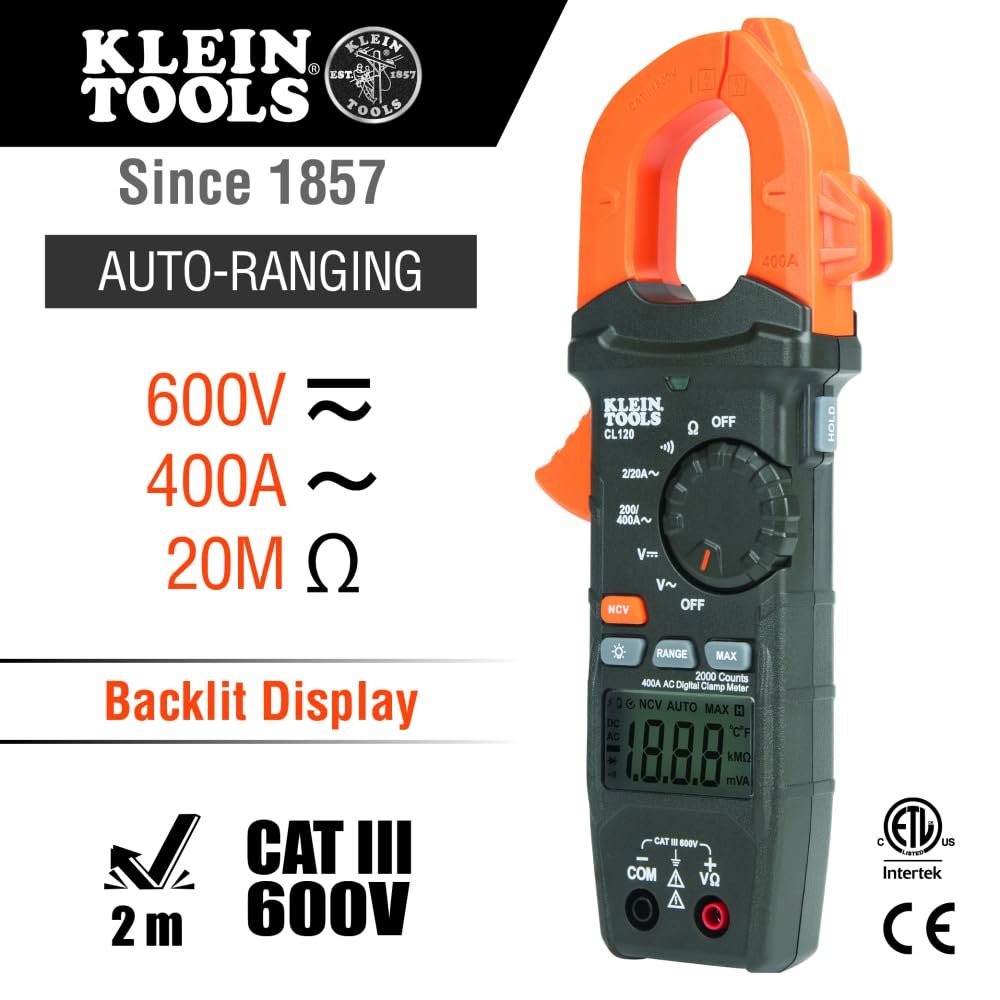
1. Klein Tools CL800 Digital Clamp Meter
The CL800 hits the sweet spot for most working electricians. It carries a CAT IV 600V and CAT III 1000V rating, reads 600A AC and DC through the clamp, and adds a LoZ mode for killing ghost voltage on long branch circuits. You can confirm the full spec sheet on Klein’s official product page.
Klein also includes a thermocouple for temperature readings and builds the meter to survive a 6.6 foot drop. For a meter priced in the mid-range, that combination is hard to beat.
| Current | 600A AC/DC |
|---|---|
| Voltage | 1000V AC/DC |
| Safety Rating | CAT IV 600V, CAT III 1000V |
| Jaw Opening | 1.38 in (35 mm) |
| Display | 6000 count, backlit |
| Extras | LoZ, temperature, capacitance, frequency, 6.6 ft drop rating |
Pros
- CAT IV 600V at a mid-range price
- Reads DC amps for solar and battery work
- LoZ mode and thermocouple included
Cons
- IP40 rating offers limited dust protection
- No wireless logging
- Runs on AAA batteries
Our Score: 9.4/10. The best balance of safety, features, and value for residential and commercial electricians.
Best for Industrial Work
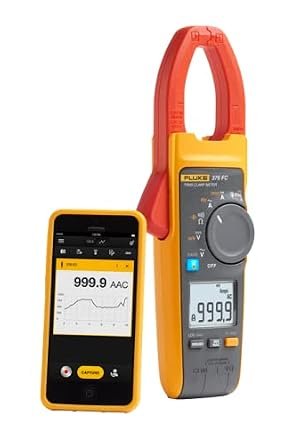
2. Fluke 376 FC True-RMS Clamp Meter with iFlex
If you work on switchgear, large motors, or main feeders, the 376 FC is the meter to beat. It measures 1000A AC and DC through the jaw, and the included iFlex flexible probe extends AC readings to 2500A around oversized or bundled conductors.
Fluke’s inrush technology captures motor starting current the way the breaker sees it. The FC suffix means Fluke Connect, so you can read measurements on your phone from a safe distance and share them with your team. Full details are on Fluke’s 376 product page.
| Current | 1000A AC/DC (2500A AC with iFlex) |
|---|---|
| Voltage | 1000V AC/DC |
| Safety Rating | CAT IV 600V, CAT III 1000V |
| Wireless | Fluke Connect app |
| Warranty | Three years |
| Extras | Inrush, min/max/average recording, low pass filter |
Pros
- Widest current range on this list
- iFlex reaches awkward conductors
- Wireless readings keep you out of the arc flash zone
Cons
- Premium price
- iFlex probe reads AC only
- More meter than most residential jobs need
Our Score: 9.3/10. The industrial benchmark, held back only by its price for everyday residential use.
Best for Residential Electricians
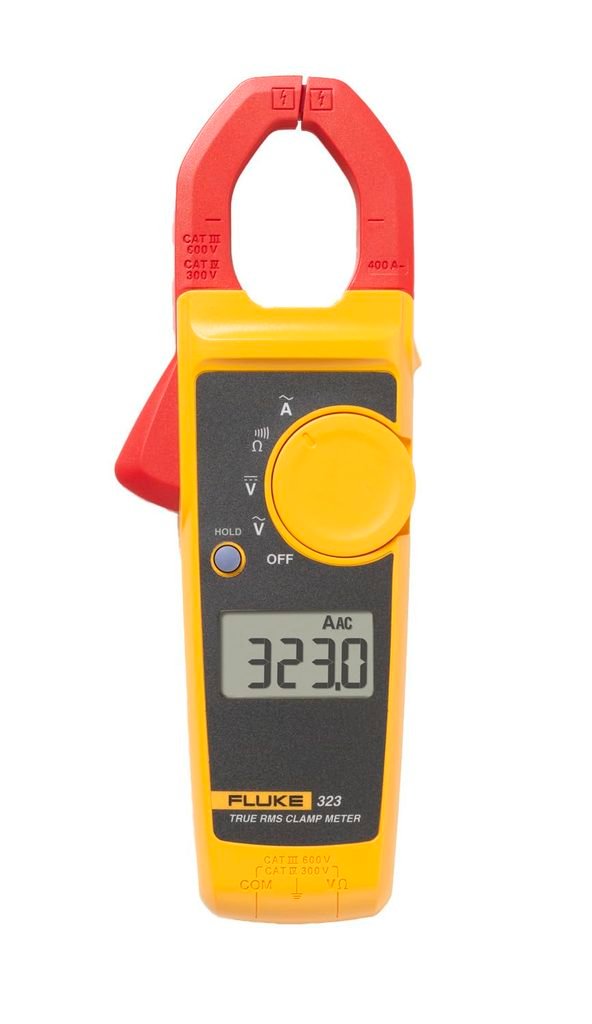
3. Fluke 323 True-RMS Clamp Meter
The Fluke 323 is a lean, focused tool for service calls. It reads 400A AC, 600V AC and DC, resistance, and continuity, and its slim jaw slides between conductors in crowded residential panels.
It carries CAT IV 300V and CAT III 600V ratings, which cover typical 120/240V residential service equipment. The trade-off is simple: no DC amps, no LoZ, and no backlight.
| Current | 400A AC |
|---|---|
| Voltage | 600V AC/DC |
| Safety Rating | CAT IV 300V, CAT III 600V |
| Max Conductor | 30 mm (600 MCM) |
| Weight | 265 g |
| Warranty | Two years |
Pros
- Fluke build quality and accuracy
- Slim, lightweight body
- Dead simple to operate
Cons
- No DC current measurement
- No backlight or LoZ mode
- CAT IV rating stops at 300V
Our Score: 8.8/10. A dependable residential workhorse for electricians who value simplicity over extras.
Best Jobsite Build
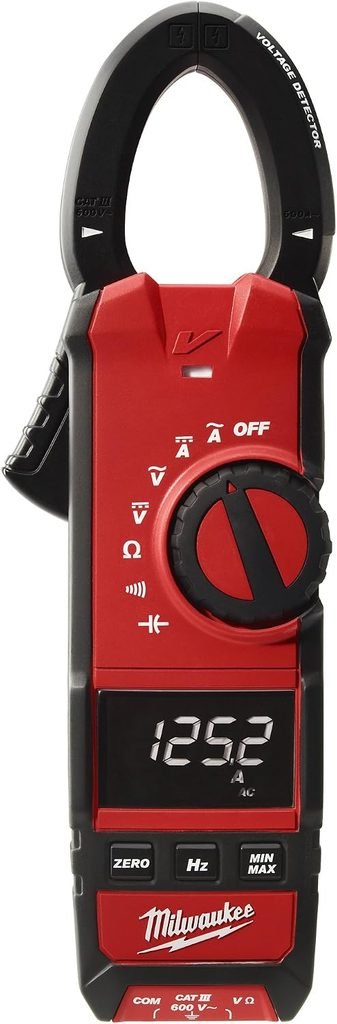
4. Milwaukee 2237-20 Clamp Meter
Milwaukee designed the 2237-20 for crews who work in dim mechanical rooms and packed panels. 600A AC/DC with a 1.3 inch jaw, a thin jaw profile, a built-in voltage detector, and an LED work light.
The white-on-black backlit display stays readable in poor light, and the five-year warranty is the longest on this list. Its CAT III 600V rating means it belongs inside distribution equipment, not at the service entrance.
| Current | 600A AC/DC |
|---|---|
| Voltage | 600V AC/DC |
| Safety Rating | CAT III 600V |
| Jaw Opening | 1.3 in |
| Extras | NCV detector, LED work light, frequency |
| Warranty | Five years |
Pros
- Thin jaw fits crowded panels
- Work light and NCV save trips to the truck
- Five-year warranty
Cons
- No CAT IV rating
- Resistance range tops out at 6 kΩ
- Some retailer listings describe it as AC-only amps, so confirm before buying
Our Score: 8.6/10. A rugged, practical meter for crews who live inside panels and mechanical rooms.
Best Budget Pick
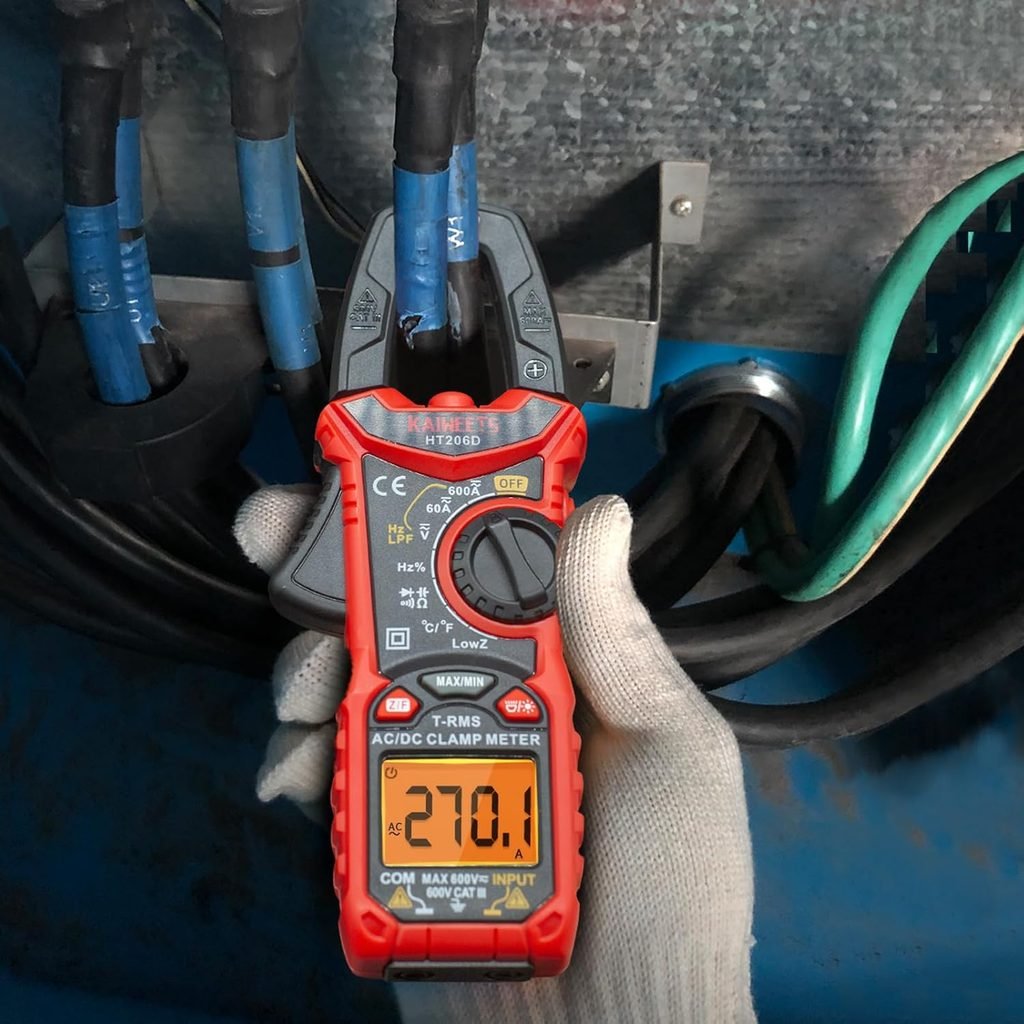
5. KAIWEETS HT206D Digital Clamp Meter
The HT206D packs a surprising feature list into an entry-level price. You get 600A AC/DC current, 600V voltage, LoZ for ghost voltage, a low pass filter for VFD work, NCV detection, and a K-type thermocouple, all certified to CAT III 600V under IEC 61010-1.
Current accuracy is looser than the name brands at plus or minus 2.5 percent, according to KAIWEETS’ published specs. For apprentices and DIY electricians, it is still a smart first clamp meter.
| Current | 600A AC/DC |
|---|---|
| Voltage | 600V AC/DC |
| Safety Rating | CAT III 600V |
| Display | 6000 count, two-color backlight |
| Extras | LoZ, LPF, NCV, temperature probe |
| Warranty | Three years |
Pros
- Pro features at a budget price
- Red backlight warns of high voltage
- Generous three-year warranty
Cons
- No CAT IV rating
- Looser current accuracy
- Less brand recognition with inspectors
Our Score: 8.1/10. The best value for apprentices and anyone building a first professional tool kit.
Final Scores at a Glance
| Rank | Model | Score | Best For |
|---|---|---|---|
| 1 | Klein Tools CL800 | 9.4/10 | Most residential and commercial electricians |
| 2 | Fluke 376 FC | 9.3/10 | Industrial and large commercial work |
| 3 | Fluke 323 | 8.8/10 | Residential service calls |
| 4 | Milwaukee 2237-20 | 8.6/10 | Crowded panels and dim mechanical rooms |
| 5 | KAIWEETS HT206D | 8.1/10 | Apprentices and tight budgets |
How We Scored These Clamp Meters
We weighted five factors: safety rating and certification (30 percent), True-RMS accuracy and current range (25 percent), troubleshooting features (20 percent), build quality and warranty (15 percent), and value (10 percent). Specifications come from manufacturer documentation, and scores reflect how well each meter fits real electrical work rather than raw spec counts.
Clamp Meter Safety Tips Every Electrician Should Follow
Inspect your test leads before every shift and replace any with cracked insulation or exposed metal. Use the live, dead, live method: prove your tester on a known live source, test the circuit, then prove the tester again. Pair your clamp meter with a dedicated voltage tester and insulated screwdrivers for a complete safe work kit.
Always clamp around a single conductor, never a whole cable. Planning a bigger job? Our project tool checklist lists everything you need before you start.
Frequently Asked Questions
What is the best clamp meter for electricians?
The Klein Tools CL800 is the best clamp meter for most electricians thanks to its CAT IV 600V rating, 600A AC/DC range, and LoZ mode. Industrial electricians should step up to the Fluke 376 FC for 1000A jaws and 2500A iFlex reach.
What CAT rating do I need for residential electrical work?
CAT III 600V covers panels, feeders, and branch circuits inside the home. If you test at the meter base or service entrance, choose a meter rated CAT IV, ideally at 600V.
Do I need a clamp meter that reads DC current?
Only if you work on solar PV, battery systems, EV chargers, or DC motors. For standard residential and commercial AC troubleshooting, an AC-only clamp like the Fluke 323 is enough.
Is a clamp meter better than a multimeter?
A clamp meter measures current without breaking the circuit, which is faster and safer on high-amperage loads. Most modern clamp meters also read voltage, resistance, and continuity, so many electricians carry one instead of a separate multimeter.
Why does my clamp meter read zero on an extension cord?
Current in the hot and neutral wires flows in opposite directions, so their magnetic fields cancel out inside the jaw. Clamp around one conductor only, or use a line splitter accessory.
Still deciding? Start with the Klein Tools CL800 for all-round work, or the Fluke 376 FC if you live in industrial switchgear.
Not sure which tester fits your job? Take the tool finder quiz.
Also Read On:
>>>https://toolexpertreviews.com/best-circuit-breaker-finder-panel-work/
>>>https://toolexpertreviews.com/best-fish-tape-for-pulling-wire/
>>>https://toolexpertreviews.com/best-thermal-imaging-camera-electrical-inspection/