Best Generator Extension Cord Picks for 2026: Plugs, Gauge and Safety
This post contains affiliate links. We earn a commission when you purchase through our links at no extra cost to you.
The best generator extension cord is the one with the right plug on each end and wire thick enough for the load and distance. Get either wrong and the cord overheats, your appliances run on low voltage, or the plug simply will not fit your generator.
As a licensed electrical engineer, I will show you how to read plug codes like L14-30 and TT-30, how to choose the wire gauge and which cords are worth buying. Then we compare seven generator cords for transfer switches, direct appliance power and RV hookups.
How I picked: I chose these from manufacturer specs, UL and ETL listings, Amazon listing details and patterns in verified owner reviews. I have not load tested every cord here, and I note where a point comes from owner feedback.
Quick Verdict: Best Generator Extension Cords
- Best Overall (Transfer Switch): Champion 25 ft 30A L14-30 Generator Power Cord
- Best Short L14-30 Cord: Southwire 20 ft 30A L14-30 Generator Cord
- Best for Running Appliances Directly: Champion 25 ft L14-30P to Four 5-20R Fan-Style Cord
- Best for 120V L5-30 Generators: Champion 25 ft L5-30P to Three 5-15R Cord
- Best 50 Amp Cord: Deeklify 25 ft 50A 14-50P to SS2-50R Cord
- Best Household Cord for Cold Weather: Iron Forge Cable 50 ft 12/3 SJTOW
- Best Heavy Gauge Household Cord: Iron Forge Cable 50 ft 10/3 SJTW
Short answer: if you have a transfer switch or inlet box, buy a 10 gauge L14-30 cord like the Champion 25 footer. Without one, a fan-style cord that splits the generator’s twist lock outlet into regular outlets is the safest way to run appliances.
Generator Plug Types Explained
NEMA codes tell you the shape and rating of a plug. The L means locking, the first number describes the voltage and wiring, and the number after the dash is the amp rating.
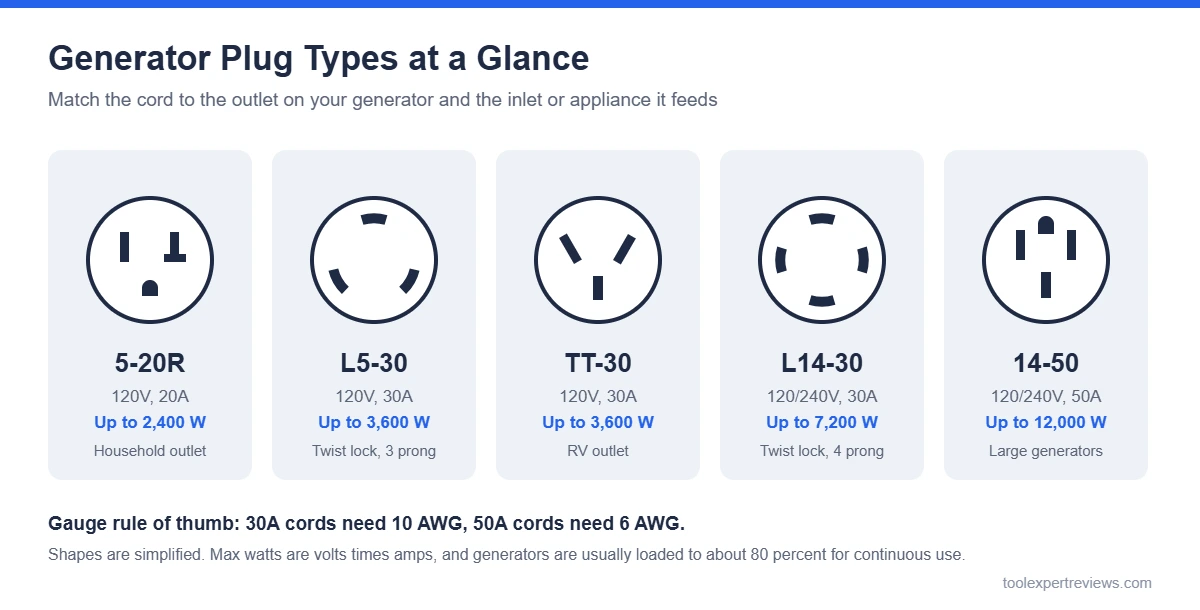
| Plug | Voltage | Amps | Max watts | Where you see it |
|---|---|---|---|---|
| 5-15 / 5-20 | 120V | 15 or 20A | 1,800 or 2,400 | Standard household outlets on most generators |
| L5-30 | 120V | 30A | 3,600 | Mid-size generators and some RVs |
| TT-30 | 120V | 30A | 3,600 | RV and camper hookups |
| L14-30 | 120/240V | 30A | 7,200 | Most 5,000 to 9,500 watt generators, transfer switch inlets |
| 14-50 | 120/240V | 50A | 12,000 | Large portable generators, 50A RVs |
| SS2-50 / CS6364 | 120/240V | 50A | 12,000 | Locking 50A generator and inlet connectors |
The max watts column is simple volts times amps. Generators are usually loaded to about 80 percent of that for continuous use.
How to Choose a Generator Extension Cord
Match Both Ends
Check the outlet on your generator and what the cord needs to plug into, such as a transfer switch inlet, an RV or household plugs. Adapters work in a pinch, but every extra connection adds resistance and a place for water to get in.
Pick the Gauge for the Load and Length
Thicker wire has a lower gauge number. A 30 amp cord should be 10 gauge, a 50 amp cord 6 gauge for the hot wires, and household cords for heavy loads should be 12 gauge or 10 gauge.
| Load | 25 ft | 50 ft | 100 ft |
|---|---|---|---|
| Up to 10A (1,200W at 120V) | 16 AWG | 14 AWG | 12 AWG |
| Up to 15A (1,800W at 120V) | 14 AWG | 12 AWG | 10 AWG |
| Up to 20A (2,400W at 120V) | 12 AWG | 10 AWG | 10 AWG |
| 30A at 120/240V (L14-30) | 10 AWG | 10 AWG | 8 AWG |
| 50A at 120/240V (14-50) | 6 AWG | 6 AWG | 4 AWG |
This table keeps voltage drop to roughly 3 to 5 percent at full load, which is a common design target. Always follow the generator and appliance manuals if they call for a heavier cord.
Keep It Short, but Not Too Short
The generator must run at least 20 feet from the house, according to the Consumer Product Safety Commission. A 25 foot cord is the practical minimum, and a 50 foot cord gives more room to place the generator away from windows.
Choose a Cold-Rated Jacket
Cord jackets are coded by letters. S means service grade, J means junior service (300V), T means vinyl, O means oil resistant outer jacket and W means rated for outdoor and wet use, so SJTOW is a good outdoor all-rounder that stays flexible in the cold.
Comparison Table
| Cord | Plug to receptacle | Length | Gauge | Jacket |
|---|---|---|---|---|
| Champion 30A Power Cord | L14-30P to L14-30R | 25 ft | 10 AWG | SJTW |
| Southwire Generator Cord | L14-30P to L14-30R | 20 ft | 10 AWG | Weather resistant |
| Champion Fan-Style 30A | L14-30P to four 5-20R | 25 ft | 10 AWG | Weather resistant |
| Champion Fan-Style L5-30 | L5-30P to three 5-15R | 25 ft | 10 AWG | Weather resistant |
| Deeklify 50A Cord | 14-50P to SS2-50R | 25 ft | Rated 50A | PVC, ETL listed |
| Iron Forge 12/3 | 5-15P to 5-15R | 50 ft | 12 AWG | SJTOW |
| Iron Forge 10/3 | 5-15P to 5-15R | 50 ft | 10 AWG | SJTW |
The 7 Best Generator Extension Cords
1. Champion 25 ft 30A L14-30 Generator Power Cord: Best Overall
This is the cord most people need to connect a generator to a manual transfer switch or power inlet box. It runs from the generator’s L14-30 twist lock outlet to an L14-30 inlet and carries the full 30 amps at 120/240V.
The 10 gauge wire and SJTW jacket stay flexible in extreme cold and heat. With nearly 6,000 Amazon ratings, it is one of the most proven generator cords available.
| Spec | Detail |
|---|---|
| Plug ends | L14-30P to L14-30R |
| Rating | 30A, 125/250V |
| Length | 25 feet |
| Wire | 10 gauge |
| Jacket | SJTW, cold and heat resistant |
| Warranty | 1 year limited |
Pros
- Full 30 amps for a transfer switch
- Flexible in cold weather
- Locking ends will not pull out
- Nearly 6,000 strong owner ratings
Cons
- 25 feet may be short if the inlet is far from a safe generator spot
- Only fits L14-30 outlets
Who should buy it: anyone connecting a 30 amp generator to a transfer switch or inlet box.
2. Southwire 20 ft 30A L14-30 Generator Cord: Best Short L14-30 Cord
Southwire is one of the largest wire makers in the US, and this cord pairs 10 gauge copper with molded twist lock ends. It is rated for 30 amps at 125/250V.
At 20 feet, it suits an inlet box where the generator can sit a safe distance away without extra slack. Owners like the stiff, durable jacket and solid molded connectors.
| Spec | Detail |
|---|---|
| Plug ends | L14-30P to L14-30R |
| Rating | 30A, 125/250V |
| Length | 20 feet |
| Wire | 10 gauge |
| Connectors | Molded, locking |
Pros
- Trusted wire brand
- Molded connectors resist water
- Less cord to coil and store
Cons
- Shorter than most picks
- Check that 20 feet reaches a spot at least 20 feet from the house
Who should buy it: owners whose inlet box sits close to a safe, open generator location.
3. Champion 25 ft L14-30P to Four 5-20R Fan-Style Cord: Best for Running Appliances Directly
If you do not have a transfer switch, this cord is the safe way to bring generator power indoors. It plugs into the generator’s 30 amp L14-30 outlet and splits it into four 20 amp household outlets at the other end.
You then plug the fridge, freezer, lamps and chargers into those outlets inside. Because the L14-30 has two 120V legs, the four outlets are split across both sides of the generator.
| Spec | Detail |
|---|---|
| Plug ends | L14-30P to four 5-20R |
| Rating | 30A total, 20A per outlet |
| Length | 25 feet |
| Wire | 10 gauge |
| Extras | Dust covers on outlets |
| Warranty | 1 year limited |
Pros
- Uses the full 30A outlet instead of the small household outlets
- Four outlets at the far end
- Over 750 strong owner ratings
Cons
- Each outlet is still limited to 20 amps
- Do not use it to feed house wiring
Who should buy it: anyone without a transfer switch who needs to run several appliances from a 30 amp generator.
4. Champion 25 ft L5-30P to Three 5-15R Cord: Best for 120V L5-30 Generators
Many mid-size and inverter generators have a 120V L5-30 twist lock outlet instead of an L14-30. This fan-style cord splits it into three 15 amp household outlets 25 feet away.
It uses 10 gauge wire with a weather resistant jacket and has over 3,500 Amazon ratings.
| Spec | Detail |
|---|---|
| Plug ends | L5-30P to three 5-15R |
| Rating | 30A total at 125V |
| Length | 25 feet |
| Wire | 10 gauge |
| Extras | Dust covers on outlets |
Pros
- Fits common L5-30 generator outlets
- Three outlets for appliances
- Thousands of strong owner ratings
Cons
- 120V only, so no 240V loads
- Each outlet is limited to 15 amps
Who should buy it: owners of generators with an L5-30 outlet who want to run appliances indoors.
5. Deeklify 25 ft 50A 14-50P to SS2-50R Cord: Best 50 Amp Cord
Large portable generators with a 14-50 outlet need a 50 amp cord to feed a 50A transfer switch or inlet. This cord runs from a 14-50 plug to a locking SS2-50 connector that fits standard 50A generator inlets such as the CS6375.
It is ETL listed, rated for 250V and 50 amps, and the maker rates the jacket from minus 40 to 212 degrees Fahrenheit.
| Spec | Detail |
|---|---|
| Plug ends | 14-50P to SS2-50R (locking) |
| Rating | 50A, 250V |
| Length | 25 feet |
| Listing | ETL |
| Temperature range | Minus 40 to 212 degrees F (maker rating) |
| Owner rating | Strong, over 250 Amazon ratings |
Pros
- Locking connector for 50A inlets
- Handles the full output of large generators
- Cold rated jacket
Cons
- Lesser known brand
- Heavy and stiff, like all 50A cords
Who should buy it: owners of large generators feeding a 50 amp transfer switch or inlet box.
6. Iron Forge Cable 50 ft 12/3 SJTOW: Best Household Cord for Cold Weather
For running a fridge, freezer or space heater from the generator’s 120V household outlets, a 12 gauge cord is the right choice at 50 feet. This SJTOW cord is oil and water resistant and rated to stay flexible from minus 40 degrees Fahrenheit.
It is UL listed for 15 amps and 1,875 watts, and has over 2,500 Amazon ratings.
| Spec | Detail |
|---|---|
| Plug ends | 5-15P to 5-15R |
| Rating | 15A, 125V, 1,875 watts |
| Length | 50 feet |
| Wire | 12 gauge |
| Jacket | SJTOW, minus 40 to 140 degrees F |
| Listing | UL |
Pros
- Right gauge for full 15A loads at 50 feet
- Stays flexible in freezing weather
- Oil resistant jacket
Cons
- Standard plugs, so one appliance per cord
- Not for twist lock outlets
Who should buy it: running one high-draw appliance from a generator household outlet in winter.
7. Iron Forge Cable 50 ft 10/3 SJTW: Best Heavy Gauge Household Cord
When you need to run a long cord to a heavy load like a sump pump or a large freezer, 10 gauge keeps voltage drop very low. This cord pairs 10 gauge wire with standard household plugs.
It is UL certified for 15 amps and rated from minus 40 to 140 degrees Fahrenheit.
| Spec | Detail |
|---|---|
| Plug ends | 5-15P to 5-15R |
| Rating | 15A, 125V, 1,875 watts |
| Length | 50 feet |
| Wire | 10 gauge |
| Jacket | SJTW |
| Listing | UL |
Pros
- Very low voltage drop
- Cold weather rated
- Over 2,500 strong owner ratings
Cons
- Heavier and bulkier than 12 gauge
- Still limited to 15A by its plugs
Who should buy it: long runs to motor loads where low voltage would strain the motor.
Generator Cord Safety Rules
- Never use a cord with two male ends to plug a generator into a wall outlet. This backfeeds the house and can kill utility workers.
- Route cords through a cord port or a door you can close against the cord, on the side of the house away from the generator exhaust.
- Uncoil cords fully when in use, because a coiled cord under heavy load can overheat.
- Keep connections off the ground and out of snow and puddles, and use a cord connector cover if possible.
- Inspect cords before every storm for cuts, crushed spots and loose plugs, and replace damaged cords.
- Do not daisy chain extension cords or plug power strips into generator cords for heavy loads.
For a cleaner, safer setup that runs hard-wired loads like the furnace, see our guide to the best transfer switch for a portable generator.
Summary
| Pick | Best for | Cord |
|---|---|---|
| Best Overall | Transfer switch or inlet box | Champion 25 ft L14-30 |
| Short L14-30 | Close inlet location | Southwire 20 ft L14-30 |
| Appliances Directly | No transfer switch | Champion L14-30P to four 5-20R |
| L5-30 Generators | 120V twist lock outlets | Champion L5-30P to three 5-15R |
| 50 Amp | Large generators | Deeklify 25 ft 50A |
| Cold Weather Household | One heavy appliance | Iron Forge 12/3 SJTOW |
| Heavy Gauge Household | Long runs to motor loads | Iron Forge 10/3 SJTW |
Frequently Asked Questions
What gauge extension cord do I need for a generator?
Use 10 gauge for a 30 amp L14-30 or L5-30 cord, and 6 gauge for a 50 amp cord. For 120V household outlets, use 12 gauge up to 50 feet for loads up to 15 amps.
Can I use a regular extension cord with a generator?
Yes, for single appliances plugged into the generator’s 120V outlets, as long as the cord is outdoor rated and heavy enough for the load. Never use a cord to connect a generator to a wall outlet.
What cord do I need for a generator transfer switch?
Most transfer switch inlets use an L14-30 connector, so you need an L14-30P to L14-30R cord in 10 gauge. A 50 amp inlet needs a matching 50 amp cord, usually 14-50P to SS2-50R.
How long can a generator extension cord be?
A 10 gauge 30 amp cord works well up to about 50 feet, and longer runs need heavier wire to limit voltage drop. Keep the generator at least 20 feet from the house.
What does L14-30 mean on a generator?
L14-30 is a NEMA twist lock connector rated for 30 amps at 120/240V. It has four prongs, two hot, one neutral and one ground, and it is the standard plug for transfer switches.
Final Word
The right generator extension cord matches your generator outlet, uses heavy enough wire and is long enough to keep the generator a safe distance from the house. For most homes with a transfer switch, the Champion 25 foot L14-30 cord is the one to buy.
Ready to connect safely? See the Champion L14-30 cord on Amazon →
Also Read On:
Best Portable Generators for Home Backup Power