
Best Transfer Switch for Portable Generator Backup Power (2026)
This post contains affiliate links. We earn a commission when you purchase through our links at no extra cost to you.
A transfer switch for portable generator backup power is the safe, code-approved way to run your furnace, well pump, fridge and lights from a generator without a tangle of extension cords. It isolates the circuits you choose from the utility, so your generator can never send power back up the line to a lineman working on it.
As a licensed electrical engineer, I see the same dangerous shortcut every storm season: a “suicide cord” plugged into a dryer outlet to backfeed the panel. This guide explains how transfer switches work, which type suits your home and generator, and compares six of the best manual transfer switch kits you can buy.
How I picked: I chose these from manufacturer specs and manuals, UL and ETL listings, Amazon listing details and patterns in verified owner reviews. I have not installed every model here myself, and installation should always be done by a licensed electrician with a permit where required.
Quick Verdict: Best Transfer Switches for Portable Generators
- Best Overall: Reliance Controls 31406 Pro/Tran 30A 6-Circuit Kit
- Best for More Circuits: Reliance Controls 31410CRK Pro/Tran 30A 10-Circuit Kit
- Best for 240V Well Pumps: Connecticut Electric EmerGen 30A 10-Circuit Kit
- Best for AFCI and GFCI Circuits: Generac 6854 HomeLink 30A Kit
- Best for 50A Generators: Connecticut Electric Series 2 50A 10-Circuit Kit
- Best for Just the Furnace: EZ Generator Switch
Short answer: for most homes with a 30 amp portable generator, the Reliance 31406 Pro/Tran kit is the simplest complete package. If your panel has AFCI or GFCI breakers on the circuits you want to back up, the Generac HomeLink is the better fit.
Why You Need a Transfer Switch
When you connect a generator to your house wiring without a transfer switch, power can flow back through your main panel and out to the utility transformer. The transformer steps that 240V up to thousands of volts on the street, which can kill a line worker who thinks the line is dead.
Backfeeding also puts your generator in a fight with the grid when power returns, which can destroy it and start a fire. The National Electrical Code requires a transfer switch or a listed interlock for any generator connected to building wiring, and most utilities require it too.
The Consumer Product Safety Commission also advises running a portable generator outside only, at least 20 feet from the house, with the exhaust pointed away. A transfer switch with an outdoor inlet makes that easy, because the generator plugs into the side of the house instead of sitting in the garage.
How a Generator Transfer Switch Setup Works
A manual transfer switch kit has three parts. The generator plugs into an outdoor power inlet box with a heavy cord, the inlet is wired to the transfer switch beside your panel, and the transfer switch connects to the circuits you choose.
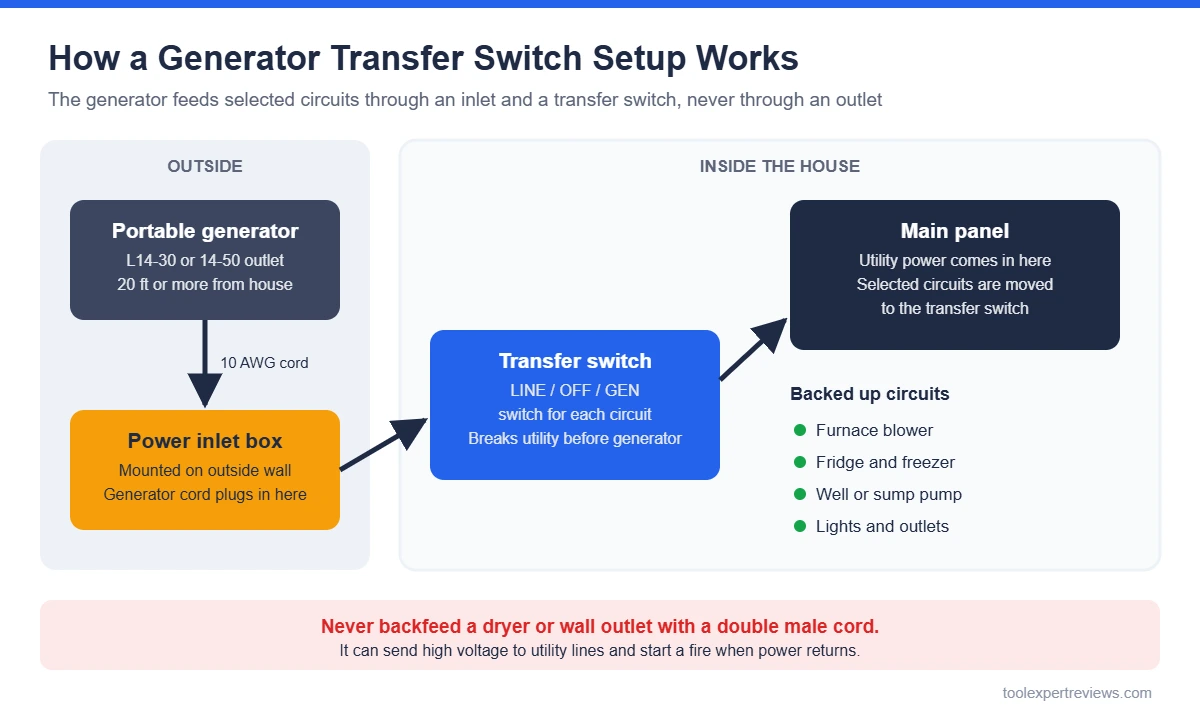
During an outage, you start the generator, plug it into the inlet and flip each circuit switch from LINE to GEN. Each switch breaks the utility connection before it makes the generator connection, so the two sources can never touch.
Transfer Switch, Interlock Kit or Automatic Switch
| Option | How it works | Pros | Cons |
|---|---|---|---|
| Manual transfer switch (this guide) | Separate box with a switch for each selected circuit | Works with any panel brand, built-in wattmeters on some, very clear to use | Limited number of circuits |
| Interlock kit | A sliding plate on your main panel that prevents the main breaker and a generator breaker from both being on | Lowest cost, lets you power any circuit in the panel | Must match your exact panel model, you manage loads by hand |
| Automatic transfer switch | Senses an outage and switches automatically | Hands-free | Mainly for standby generators, far more expensive |
An interlock is a great option if one is listed for your exact panel, since it can back up any circuit. A manual transfer switch is the more universal choice and the one most homeowners with a portable generator end up with.
How to Choose a Transfer Switch for a Portable Generator
Match the Amp Rating to Your Generator Outlet
Look at the largest outlet on your generator. A 4 prong L14-30 twist lock outlet means a 30 amp switch, which handles up to about 7,500 running watts, and a 14-50 outlet means a 50 amp switch for up to about 12,500 watts.
If your generator only has a 120V L5-30 outlet, it cannot power 240V circuits like a well pump. Some kits include an adapter, but your 240V loads will not run.
Count the Circuits You Actually Need
List the essentials: furnace blower, fridge, freezer, well pump, sump pump, a few lights and outlets for phones and a TV. Most homes land between 6 and 10 circuits, and 240V loads use two switch positions each.
Check for AFCI and GFCI Breakers
Many newer homes have AFCI or GFCI breakers on bedroom, kitchen and bath circuits. Switches with their own built-in breakers, like the Reliance Pro/Tran, bypass that protection, so choose a switch that accepts your panel’s AFCI and GFCI breakers if those circuits matter to you.
Plan the Cord and Inlet Location
The inlet box should sit outside, where the generator can run at least 20 feet from doors and windows. You will also need a cord with the right plugs, which we cover in our guide to the best generator extension cords.
Comparison Table
| Kit | Rating | Circuits | Max watts | Inlet and cord | Notes |
|---|---|---|---|---|---|
| Reliance 31406 Pro/Tran | 30A | 6 positions | 7,500 | Inlet and cord in CRK kit | Dual wattmeters |
| Reliance 31410CRK Pro/Tran | 30A | 10 positions | 7,500 | Inlet and cord in kit | Dual wattmeters |
| Connecticut Electric EmerGen | 30A | 10 (four 240V) | 7,500 | Inlet and 10 ft cord in kit | NEMA 3R, indoor or outdoor |
| Generac 6854 HomeLink | 30A | 8, expands to 10 | 7,500 | Check listing for inlet and cord | Takes AFCI and GFCI breakers |
| Connecticut Electric Series 2 50A | 50A | 10 | 12,500 | 50A inlet and 25 ft cord in kit | For large generators |
| EZ Generator Switch | 20A | 1 (furnace) | 120V circuit | Plug-in | Furnace and boiler only |
The 6 Best Transfer Switches for Portable Generators
1. Reliance Controls 31406 Pro/Tran 30A 6-Circuit Kit: Best Overall
The Pro/Tran 6-circuit kit is the classic choice for a 30 amp portable generator. It mounts beside your panel with a pre-wired flexible conduit whip, so an electrician can install it without pulling the meter or adding a subpanel.
Two analog wattmeters show the load on each side of the generator, which helps you balance loads and avoid tripping the generator breaker. The CRK kit version adds a raintight 30A inlet box and a 10 foot L14-30 cord, so check which version the listing ships.
| Spec | Detail |
|---|---|
| Rating | 30A, 125/250V, up to 7,500 watts |
| Circuits | Four 15A single pole and one 20A double pole (6 positions) |
| Switches | Double throw, break before make |
| Meters | Dual wattmeters |
| CRK kit adds | 30A inlet box (NEMA 3R), 10 ft L14-30 cord, 20A plug option |
| Listing | UL listed |
Pros
- Available as a complete kit with inlet and cord
- Wattmeters make load balancing easy
- Works with any panel brand
- Over 1,700 strong Amazon ratings
Cons
- Built-in breakers bypass AFCI and GFCI protection
- Six positions fill up fast if you have 240V loads
- Suitable only for circuits protected by 20A or smaller breakers
Who should buy it: homeowners with a 30 amp generator who want a proven, complete kit for the essentials.
2. Reliance Controls 31410CRK Pro/Tran 30A 10-Circuit Kit: Best for More Circuits
The 31410CRK is the same Pro/Tran design with ten positions instead of six. That leaves room for a 240V well pump plus the furnace, fridge, freezer, sump and lighting circuits.
It supports up to 10 single pole or 5 double pole circuits and handles generators up to 7,500 running watts. The powder coated steel cabinet has six combination knockouts.
| Spec | Detail |
|---|---|
| Rating | 30A, up to 7,500 running watts |
| Circuits | Up to 10 single pole or 5 double pole |
| Meters | Dual wattmeters |
| Whip | 18 inch flexible conduit to the panel |
| Cabinet | Powder coated steel |
| Listing | UL listed |
Pros
- Room for a well pump and the essentials
- Wattmeters for load balancing
- Over 1,200 strong Amazon ratings
Cons
- Built-in breakers bypass AFCI and GFCI protection
- Larger box needs more wall space
Who should buy it: larger homes, or anyone who needs a 240V well pump plus several 120V circuits.
3. Connecticut Electric EmerGen 30A 10-Circuit Kit: Best for 240V Well Pumps
The EmerGen kit stands out for its four 2 pole 240V circuits, which makes it a strong pick for homes on a well pump or with a 240V sump. If you do not need 240V, the tie bars come off to give four more single pole circuits.
The switch and inlet carry a NEMA 3R rainproof rating, so the switch can mount indoors or outdoors. Double throw rocker switches prevent backfeeding, and the kit is ETL listed.
| Spec | Detail |
|---|---|
| Rating | 30A, 240V, up to 7,500 watts |
| Circuits | 10, including four 2 pole 240V |
| Enclosure | NEMA 3R, indoor or outdoor |
| Included | Inlet and 10 ft cord |
| Compatibility | Works with all residential load centers |
| Listing | ETL listed |
Pros
- Four 240V circuits for well and sump pumps
- Can mount outdoors
- Over 1,300 strong Amazon ratings
Cons
- No wattmeters
- Built-in breakers, so AFCI and GFCI protection is bypassed
Who should buy it: rural homes on a well, or anyone with several 240V loads to back up.
4. Generac 6854 HomeLink 30A Kit: Best for AFCI and GFCI Circuits
The HomeLink uses standard plug-in breakers instead of built-in ones, and it accepts tandem, GFCI and AFCI breakers. That means circuits that require arc fault or ground fault protection keep it while on generator power.
It ships for 8 circuits and expands to 10, has indicator lights for utility and generator power and can be upgraded to automatic operation later with a HomeLink upgrade kit.
| Spec | Detail |
|---|---|
| Rating | 30A, for generators up to 7,500 watts |
| Circuits | 8, expandable to 10 |
| Breakers | Accepts standard, tandem, GFCI and AFCI |
| Indicators | Utility and generator power lights |
| Upgrade | Convertible to automatic with HomeLink kit |
| Inlet | Check the listing for what is included |
Pros
- Keeps AFCI and GFCI protection on backed up circuits
- Can be upgraded to automatic later
- Status lights show which source is live
Cons
- Confirm the inlet box and cord are included before you buy
- Fewer owner reviews than the Reliance kits
Who should buy it: newer homes with AFCI or GFCI breakers on the circuits you want to back up.
5. Connecticut Electric Series 2 50A 10-Circuit Kit: Best for 50A Generators
If your generator has a 14-50 outlet and runs above 7,500 watts, a 30 amp switch wastes its capacity. This Series 2 kit is rated for 50 amp generators and up to 12,500 watts.
It includes a 50A power inlet box and a 25 foot cord, so the generator can sit well away from the house. Double throw rocker switches block backfeeding, and the kit is ETL certified.
| Spec | Detail |
|---|---|
| Rating | 50A, up to 12,500 watts |
| Circuits | 10, with 240V switching |
| Included | 50A inlet box (CS6375) with cover, 25 ft cord |
| Switches | Double throw rocker |
| Listing | ETL certified |
Pros
- Uses the full output of a large generator
- Long 25 foot cord included
- Handles well pumps and other 240V loads
Cons
- More than a 30 amp generator needs
- Newer model with fewer owner reviews
Who should buy it: owners of large portable generators with a 14-50 outlet who want to run more of the house.
6. EZ Generator Switch: Best for Just the Furnace
In a winter outage, the furnace or boiler is often the one circuit that matters most. The EZ Generator Switch replaces the furnace service switch and gives it a dedicated inlet, so you can run a gas or oil furnace from a small generator or a large inverter.
It is UL, CSA and ETL listed, works with bonded or floating neutral generators and is made in the USA.
| Spec | Detail |
|---|---|
| Rating | 20A, 120V |
| Circuits | 1 (furnace, boiler or other single load) |
| Listing | UL, CSA and ETL |
| Neutral | Works with bonded or floating neutral |
| Made in | USA |
| Owner rating | Strong, over 900 Amazon ratings |
Pros
- Simple way to keep the heat on
- Works with small generators and battery inverters
- Very affordable compared to a full kit
Cons
- Only one circuit
- Not for well pumps or 240V loads
Who should buy it: anyone whose main worry in an outage is keeping a gas or oil furnace running.
How to Size Your Generator and Switch
Add up the running watts of everything you want on at once, then add the largest starting surge. Fridges, freezers, well pumps and furnace blowers all draw extra current for a second or two when they start.
| Load | Typical running watts | Notes |
|---|---|---|
| Furnace blower (gas) | 400 to 800 | Higher start surge |
| Refrigerator | 150 to 400 | Cycles on and off |
| Chest freezer | 100 to 300 | Cycles on and off |
| Well pump (1/2 hp, 240V) | 700 to 1,000 | Start surge can be two to three times running |
| Sump pump (1/2 hp) | 800 to 1,050 | High start surge |
| LED lighting circuit | 50 to 200 | Depends on fixtures |
| TV, router and phone chargers | 100 to 300 | Low steady load |
These are typical ranges, not ratings for your appliances, so check the nameplate on each one. A 7,500 watt generator on a 30 amp switch comfortably runs the essentials if you stagger the large motor loads.
Installation and Safety Tips
- Have a licensed electrician install the switch and inlet, and pull a permit where your town requires one.
- Run the generator outside only, at least 20 feet from the house, with the exhaust pointed away from doors and windows.
- Install battery powered carbon monoxide alarms on every level of the home.
- Never plug a generator into a wall outlet or dryer outlet with a double male cord.
- Start the generator before flipping circuits to GEN, and switch back to LINE before shutting it off.
- Balance loads between the two sides using the wattmeters if your switch has them.
Before working on any generator connection, verify circuits are dead with a proper tester. See our guides to the best voltage testers for generator hookup and the best portable generators for home backup.
Summary
| Pick | Best for | Kit |
|---|---|---|
| Best Overall | Most homes with a 30A generator | Reliance 31406 Pro/Tran |
| More Circuits | Well pump plus essentials | Reliance 31410CRK |
| 240V Loads | Well and sump pumps | Connecticut Electric EmerGen 30A |
| AFCI and GFCI | Newer homes | Generac 6854 HomeLink |
| 50A Generators | Large portable generators | Connecticut Electric Series 2 50A |
| Furnace Only | Keeping the heat on | EZ Generator Switch |
Frequently Asked Questions
Do I need a transfer switch for a portable generator?
Yes, if you want to power circuits in your house wiring. The National Electrical Code requires a transfer switch or a listed interlock, because it prevents dangerous backfeeding to the utility lines.
What size transfer switch do I need for my generator?
Match the switch to the generator outlet. An L14-30 outlet calls for a 30 amp switch for up to about 7,500 watts, and a 14-50 outlet calls for a 50 amp switch for up to about 12,500 watts.
Can I install a generator transfer switch myself?
Installing a transfer switch means working inside your main panel, so it should be done by a licensed electrician. Many towns also require a permit and inspection.
Is an interlock kit better than a transfer switch?
An interlock costs less and lets you power any circuit, but it must be listed for your exact panel. A manual transfer switch works with any panel and limits you to the circuits you wire to it.
How far should a portable generator be from the house?
The Consumer Product Safety Commission advises running a portable generator outside only, at least 20 feet from the house, with the exhaust directed away from doors and windows.
Final Word
A transfer switch for a portable generator is the one piece that makes backup power both safe and convenient. For most homes the Reliance 31406 Pro/Tran kit is the easiest complete package, while the Generac HomeLink is the better pick when your circuits need AFCI or GFCI protection.
Ready to set up safe backup power? See the Reliance 31406 kit on Amazon →
Also Read On:
Best Portable Generators for Home Backup Power