Best Borescope Inspection Camera for 2026: 6 Top Picks Compared
Finding the best borescope inspection camera can save you from cutting open a wall, pulling an engine head, or calling a plumber for a problem you could see yourself. A good borescope lets you look inside pipes, walls, cylinders, and ducts through a hole smaller than a pencil. This guide compares six proven models so you can pick the right one in a few minutes.
We independently evaluate every recommendation. If you buy through our links, we may earn a commission at no extra cost to you.
Quick Verdict: Our Top Picks
- Best Overall: Teslong NTS500 Pro, with a sharp 5 inch screen, dual lenses, and an IP67 probe.
- Best Articulating: Teslong TD500, which steers its tip up to 210 degrees to look around corners.
- Best Value: DEPSTECH DS300 Dual Lens, offering a 16.5 ft cable and 1080P video at a budget price.
- Best for Trade Pros: Milwaukee M12 M-Spector 360, built tough and powered by M12 batteries.
- Best for Plumbers: RIDGID micro CA-300, which expands to 30 ft and works with RIDGID reels.
- Best Wi-Fi Model: Klein Tools ET20, a rugged phone-based scope with 5.5 hours of battery life.
Why a Borescope Is Worth Owning
Borescopes used to be expensive industrial tools reserved for aircraft engines and factory equipment. Today, homeowners, mechanics, and electricians use them every week. The numbers show how fast the category is growing.
$0.7BGlobal borescope market value in 2025
6.8%Projected yearly growth through 2034
9,300 galWater lost to leaks per US home each year
According to Market Intelo, the global borescope market was worth about $0.7 billion in 2025 and is projected to reach $1.2 billion by 2034. That growth comes from cheaper sensors, better screens, and more DIY users. More competition also means better cameras for less money.
Leak hunting is one of the most common reasons people buy a borescope. The EPA WaterSense program reports that household leaks waste about 1 trillion gallons of water nationwide every year. It also notes that 9 percent of homes have leaks wasting 50 gallons or more per day.
A borescope helps you find that hidden leak through a small hole instead of a large section of torn out drywall. It also helps you check engine cylinders for carbon, inspect HVAC ducts, find a dropped part inside an appliance, or trace a cable path before drilling.
How to Choose the Best Borescope Inspection Camera
Not every borescope suits every job. Focus on these six features before you buy.
1. Probe Diameter
The probe diameter decides which holes the camera can enter. A 5.5 mm to 6.5 mm probe fits spark plug holes and small fittings. An 8 mm to 9 mm probe is a good all round size for walls and drains, while a 17 mm head suits larger pipes.
2. Cable Length and Stiffness
Short cables of 3 to 5 ft are easier to control inside engines and wall cavities. Longer cables of 16 ft or more are better for drains, attics, and crawl spaces. A semi rigid cable holds its shape, which helps you aim the camera where you want it.
3. Single Lens, Dual Lens, or Articulating
A single lens only looks forward. A dual lens camera adds a side view, which is ideal for reading pipe walls and cylinder walls. An articulating camera physically bends its tip so you can look around corners, and it costs more.
4. Screen or Smartphone
Built in screens work instantly and do not drain your phone. Wi-Fi models stream to an app, which gives you a bigger display and easy sharing with clients. If you work in basements or metal buildings, a built in screen is often more reliable.
5. Image Quality and Lighting
Look for at least 720p, with 1080p preferred for photos you plan to share. Adjustable LEDs matter as much as resolution because shiny pipes and wet surfaces cause glare. Check the focus range too, since most borescopes focus best between about 1 and 3 inches.
6. Waterproof Rating
An IP67 rating means the probe is dust tight and can survive immersion to 1 meter for 30 minutes under the IEC 60529 standard. That rating is essential for drains, toilets, and wet engine bays. Remember that the main body is usually less protected than the probe.
Borescope Specs Comparison Table
| Model | Probe Size | Cable | Display | Lens Type | Waterproof | Price Range |
|---|---|---|---|---|---|---|
| Teslong NTS500 Pro | 5.5 or 8.0 mm | 3.2 to 16.4 ft | 5 in screen | Dual lens | IP67 | Mid |
| Teslong TD500 | 6.5 mm | 5 ft | 5 in screen | Dual lens, articulating | IP67 | Upper mid |
| DEPSTECH DS300 | 7.9 mm | 16.5 ft | 4.3 in screen | Dual lens | IP67 | Budget |
| Milwaukee M-Spector 360 | 9 mm | 3 ft | 2.7 in rotating | Single lens | Waterproof head | Mid |
| RIDGID micro CA-300 | 17 mm | 3 ft, up to 30 ft | 3.5 in screen | Single lens | Waterproof head | Premium |
| Klein Tools ET20 | 9 mm | 6 ft | Smartphone app | Single lens | IP67 probe | Mid |
Want to line these up against other inspection tools? Try our side by side tool comparison.
Best Borescope Inspection Camera Reviews
1. Teslong NTS500 Pro: Best Overall
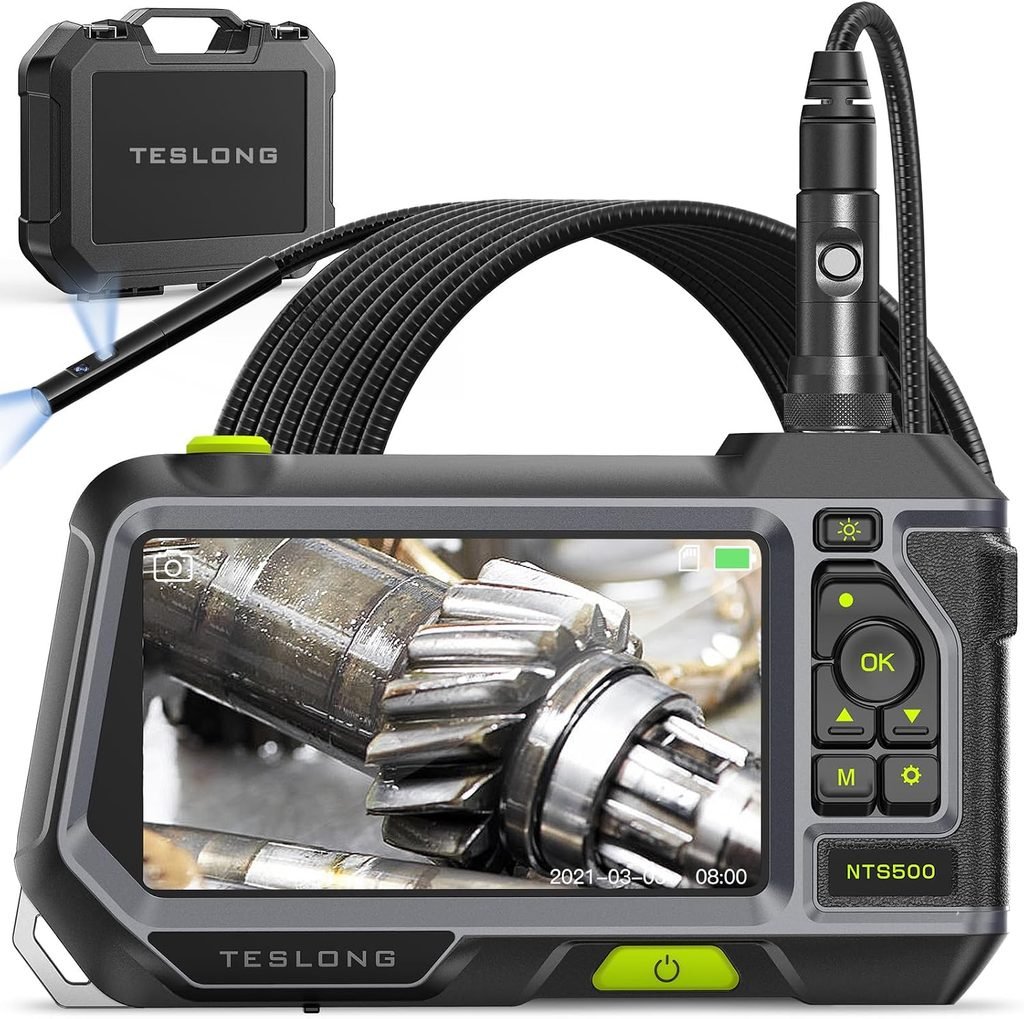
The Teslong NTS500 Pro gets the balance right for most buyers. Its 5 inch IPS screen is large and bright, and the dual lens camera lets you switch between straight and side views with one button. You can choose a 5.5 mm or 8.0 mm probe in lengths from 3.2 ft to 16.4 ft.
The 3500 mAh battery delivers 4 to 5 hours of use, and a 32 GB microSD card is included. Six adjustable LEDs on the front lens help control glare inside shiny copper pipe.
| Probe | 5.5 mm or 8.0 mm, IP67 |
| Screen | 5 in, 1280 x 720 |
| Photo / Video | 1920 x 1080 / 1280 x 720 |
| Battery | 3500 mAh, 4 to 5 hours |
Pros
- Large, clear 5 inch display
- Choice of probe size and length
- Dual lens with quick switching
Cons
- Video records at 720p
- No articulating tip
9.3/10Verdict: The best choice for homeowners and mechanics who want one scope for nearly every job.
2. Teslong TD500: Best Articulating Borescope
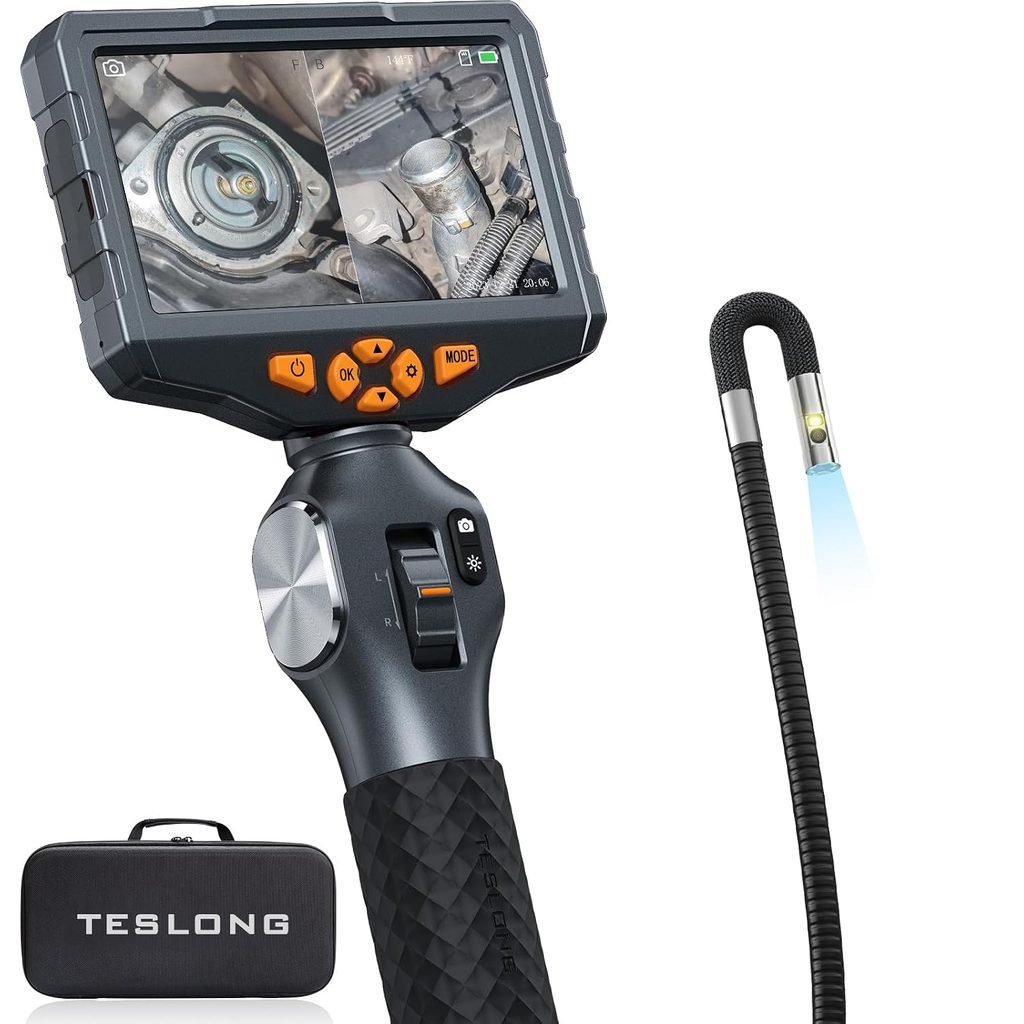
The TD500 lets you steer the camera tip in two directions, up to 210 degrees, using a thumb control. That means you can look back at the underside of a valve or around the bend inside a wall. Its slim 6.5 mm probe fits most spark plug holes.
You still get dual lenses, a 5 inch screen, and 1080p capture. The 5 ft probe is shorter than most, so treat this as a precision tool rather than a drain camera.
| Probe | 6.5 mm, 5 ft, IP67 |
| Articulation | Two way, up to 210 degrees |
| Screen | 5 in, 854 x 480 |
| Battery | 3000 mAh, 3 to 4 hours |
Pros
- Steerable tip sees around corners
- Slim probe for engines
- Dual lens plus 1080p capture
Cons
- Short 5 ft reach
- Lower screen resolution
9.0/10Verdict: The pick for auto techs and anyone who needs to see behind obstacles.
3. DEPSTECH DS300 Dual Lens: Best Value
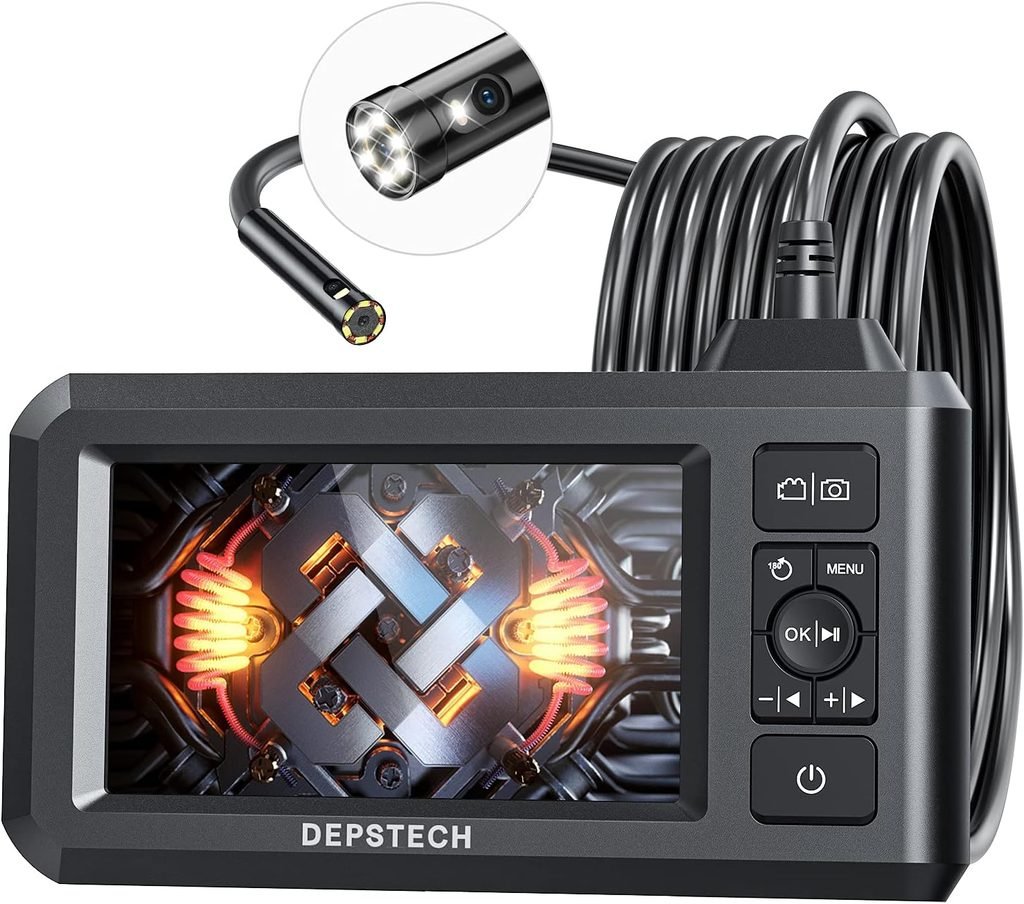
The DEPSTECH DS300 packs features usually found on pricier scopes. You get a 4.3 inch IPS screen, a 7.9 mm dual lens probe, 2.0 MP photos, and 1080P video. The 16.5 ft semi rigid cable reaches deep into drains and crawl spaces.
Battery life runs about 4 hours, and a 32 GB card comes in the box. The smaller screen is the main trade off.
| Probe | 7.9 mm, 16.5 ft, IP67 |
| Screen | 4.3 in IPS |
| Photo / Video | 2.0 MP / 1080P |
| Battery | About 4 hours |
Pros
- Long 16.5 ft cable
- Dual lens at a budget price
- 1080P video recording
Cons
- Smaller 4.3 inch screen
- Long cable is awkward in tight spaces
8.8/10Verdict: The smartest buy for DIY users who want long reach without overspending.
4. Milwaukee M12 M-Spector 360: Best for Trade Pros
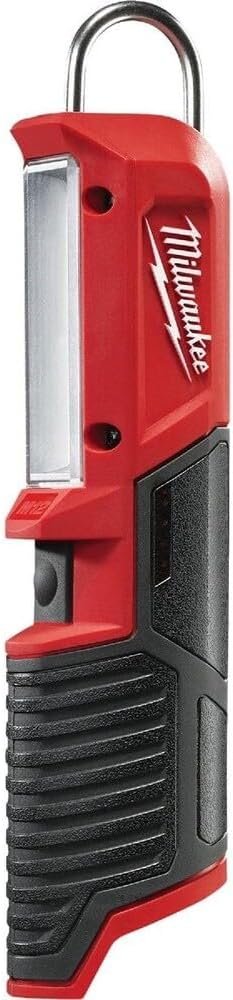
Milwaukee built the M-Spector 360 for jobsite abuse. The 2.7 inch screen rotates 360 degrees so you can view at any angle, and the 9 mm head is waterproof and resists gas and oil. The kit includes an M12 REDLITHIUM battery and charger.
If you already own M12 tools, you can swap batteries and keep working. Image quality is modest at 640 x 480, but it is clear enough for most diagnostic work.
| Probe | 9 mm, 3 ft cable |
| Screen | 2.7 in, rotates 360 degrees |
| Image Sensor | 640 x 480 |
| Power | M12 battery (included in 2313-21 kit) |
Pros
- Tough, jobsite ready build
- Shares M12 batteries
- Rotating display
Cons
- Lower resolution
- Short 3 ft cable on this kit
8.6/10Verdict: Ideal for electricians and HVAC techs already on the Milwaukee M12 platform.
5. RIDGID micro CA-300: Best for Plumbers
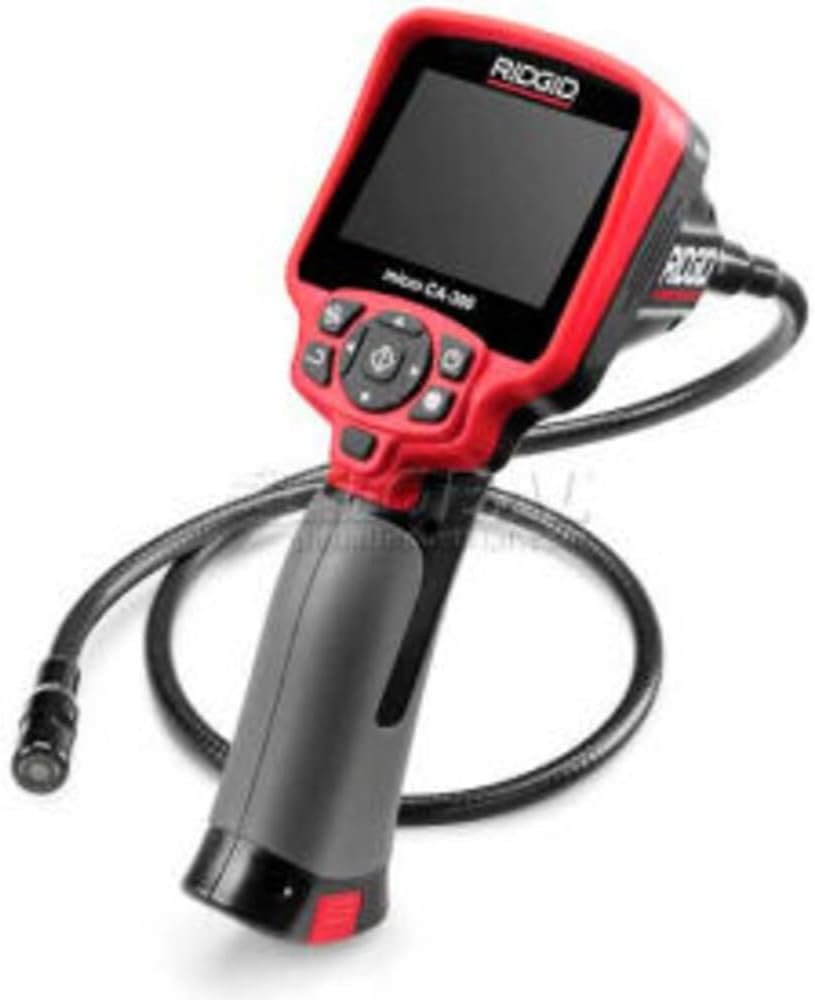
The RIDGID micro CA-300 is a professional system rather than a single camera. Its 3 ft cable extends to 30 ft with optional extensions, and it works with RIDGID microDrain, microReel, and nanoReel systems. The 17 mm aluminum head is built for drains and larger pipe.
A built in microphone and included headset let you narrate findings while recording. Resolution is modest, so this model suits plumbers who value reach and expandability over sharp photos.
| Head | 17 mm aluminum, waterproof |
| Cable | 3 ft, expandable to 30 ft |
| Screen | 3.5 in, 320 x 240 |
| Storage | SD card, 4 GB included |
Pros
- Expands to 30 ft and reel systems
- Audio narration for client reports
- Long list of included accessories
Cons
- Premium price
- 17 mm head is too large for small holes
8.5/10Verdict: A long term investment for plumbers who want one camera that grows with their business.
6. Klein Tools ET20: Best Wi-Fi Borescope
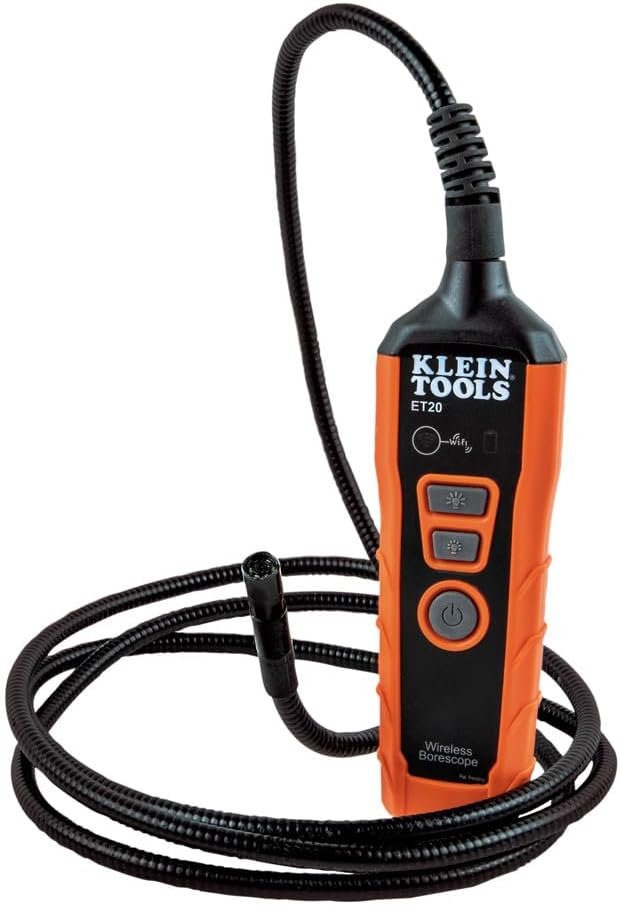
The Klein ET20 streams video to your smartphone over Wi-Fi at up to 30 ft. The 6 ft armored gooseneck cable and 9 mm camera are IP67 rated, and the unit passed a 3 meter drop test. Battery life reaches 5.5 hours, which is the longest in this guide.
Because it uses your phone as the display, sharing photos with a client or supervisor is instant. Resolution is 640 x 480, which is fine for tracing cables and checking junction boxes.
| Probe | 9 mm, 6 ft armored gooseneck, IP67 |
| Display | Smartphone via Wi-Fi, up to 30 ft |
| Resolution | 640 x 480 |
| Battery | 5.5 hours |
Pros
- Longest battery life here
- Rugged, drop tested body
- Easy photo sharing
Cons
- Needs a phone to operate
- Lower resolution
8.4/10Verdict: A tough, phone based scope that electricians will appreciate on daily service calls.
Electricians often pair a borescope with a reliable tester before opening any box. See our guide to the best voltage tester for generator hookup for proven options.
Final Scores Summary
| Rank | Model | Best For | Score |
|---|---|---|---|
| 1 | Teslong NTS500 Pro | Overall use | 9.3/10 |
| 2 | Teslong TD500 | Engines and tight corners | 9.0/10 |
| 3 | DEPSTECH DS300 | Budget buyers | 8.8/10 |
| 4 | Milwaukee M-Spector 360 | M12 trade pros | 8.6/10 |
| 5 | RIDGID micro CA-300 | Plumbers | 8.5/10 |
| 6 | Klein Tools ET20 | Wi-Fi and electricians | 8.4/10 |
Safety Tips Before You Inspect
Always switch off power at the breaker before pushing a camera into an outlet box or wall cavity near wiring. Never insert a probe into a running engine, a live electrical panel, or a pressurized line. Clean and dry the probe after every drain inspection to prevent bacteria and corrosion.
Planning a bigger repair? Our project tool checklist lists everything you need before you start.
Frequently Asked Questions
What is the difference between a borescope and an endoscope?
The two terms are often used for the same tool. Technically, a borescope is for inspecting machines and buildings, while an endoscope is a medical device. Most consumer “endoscope” cameras sold online are actually borescopes.
Is a dual lens borescope worth it?
Yes, for most buyers. The side view lens lets you read pipe walls, cylinder walls, and wall cavities without bending the cable. It adds only a modest cost over a single lens model.
Can I use a borescope to find water leaks?
Yes. Drill a small hole near the suspected leak and feed the probe inside to check for moisture, stains, or mold. This is far less destructive than removing drywall.
What probe size do I need for engine inspection?
A probe of 6.5 mm or smaller fits most spark plug holes. An articulating model like the Teslong TD500 makes it easier to see cylinder walls and valves.
Are Wi-Fi borescopes better than ones with screens?
Not always. Wi-Fi models give you a bigger display and easy sharing, but they rely on your phone and a stable connection. Built in screens are faster to use and more dependable on busy jobsites.
Ready to See Inside?
For most people, the Teslong NTS500 Pro is the best borescope inspection camera you can buy today. Choose the TD500 for engines, the DS300 for value, or a Milwaukee, RIDGID, or Klein model if you work in the trades.
Also Read On:
>>>How to Store Lithium Tool Batteries in Winter: 7 Steps to Protect Your Packs
>>>Best OBD2 Scanners for Home Mechanics: 5 Top Picks for 2026
>>>Best Cordless Tire Inflators for Winter Driving: 5 Top Picks