Best Torque Wrenches for Accurate Fastening
Choosing the best torque wrenches for accurate fastening comes down to one question: how close does the tool land to the number you dialled in? A wheel nut, a cylinder head bolt and a carbon seatpost all fail in different ways when that number is wrong. This guide covers six wrenches I trust, the accuracy ratings that matter, and the habits that keep a wrench honest for years.
I am an electrical engineer by trade, so I spend as much time on terminal lugs and switchgear fasteners as I do under a car. The physics is the same everywhere. Get the clamp load right and the joint stays put.
This post contains affiliate links. We earn a commission when you purchase through our links at no extra cost to you. We only recommend products we’ve personally tested and use ourselves.
Quick Verdict: Top Picks at a Glance
- Best overall: TEKTON 24335 1/2-Inch Click Torque Wrench
- Best professional grade: CDI 2503MFRPH Micrometer Torque Wrench
- Best digital: ACDelco ARM601-4 Digital Torque Wrench
- Best split-beam: Precision Instruments PREC3FR250F
- Best for bikes and low torque: Park Tool TW-5.2
- Best for small fasteners: TEKTON 24320 1/4-Inch Drive
Why Torque Accuracy Matters More Than You Think
Here is the statistic that reframes the whole job. According to Nord-Lock Group, roughly 50 percent of the torque you apply is eaten by friction under the bolt head and another 40 percent by friction in the threads. Only about 10 percent actually stretches the fastener and creates clamp load.
That 90/10 split is why guesswork fails. A quarter turn past spec on an aluminium thread is not “a bit tight”, it is a stripped hole. A quarter turn short on a wheel is a nut that walks loose over a few hundred miles.
It also explains why even a calibrated wrench leaves scatter. Engineers working to the torque control method typically plan for 25 to 30 percent variation in the resulting clamp force, because friction changes with plating, lubricant and surface finish. Your wrench removes the biggest variable you control, which is the torque itself.
How to Choose a Torque Wrench
1. Accuracy Rating and the ISO 6789 Standard
The global benchmark is ISO 6789, which sets a permissible deviation of plus or minus 4 percent for click-type wrenches and plus or minus 6 percent for beam types. Labs verify tools at 20 percent, 60 percent and 100 percent of capacity. Anything advertised without a stated tolerance should be treated as a bar with a handle.
Digital wrenches usually claim plus or minus 2 to 3 percent, and the better mechanical units from calibration-focused brands hold 3 percent clockwise. For a home garage, 4 percent is fine. For engine internals and head bolts, tighter is worth paying for.
2. Use the Middle of the Range
Accuracy is only guaranteed between 20 percent and 100 percent of full scale, as the Mountz torque engineering team explains. A 10 to 150 ft-lb wrench set to 8 ft-lb is operating outside its verified window.
This is the single most common buying mistake. People buy one big 1/2-inch wrench and then use it for interior trim bolts. Two wrenches covering different bands beat one wrench stretched thin.
3. Drive Size Matched to the Job
A 1/2-inch drive covers lug nuts, suspension and most chassis work from roughly 30 to 250 ft-lb. A 3/8-inch drive handles engine accessories, brakes and bike components. A 1/4-inch drive in inch-pounds is for sensors, covers, electronics and anything threaded into plastic or thin alloy.
4. Mechanism Type
Click wrenches are the default: cheap, tactile and reliable, but they need to be wound back to their lowest setting after use. Split-beam wrenches skip that step entirely because there is no spring held under load. Digital wrenches add angle modes, unit switching and an audible alert, at the cost of batteries.
5. Calibration Interval
Manufacturers and calibration labs generally recommend verification every 12 months or every 5,000 cycles, whichever comes first. A wrench that has been dropped should be checked immediately, regardless of the calendar. Budget for this the way you budget for consumables.
Specification Comparison
| Model | Drive | Range | Accuracy | Type |
|---|---|---|---|---|
| TEKTON 24335 | 1/2 in | 10 to 150 ft-lb | +/- 4% | Click |
| CDI 2503MFRPH | 1/2 in | 30 to 250 ft-lb | +/- 3% CW | Click |
| ACDelco ARM601-4 | 1/2 in | 12.5 to 250 ft-lb | +/- 2% CW | Digital |
| Precision Instruments PREC3FR250F | 1/2 in | 25 to 250 ft-lb | +/- 4% | Split-beam |
| Park Tool TW-5.2 | 3/8 in | 2 to 14 Nm | +/- 4% | Click |
| TEKTON 24320 | 1/4 in | 20 to 200 in-lb | +/- 4% | Click |
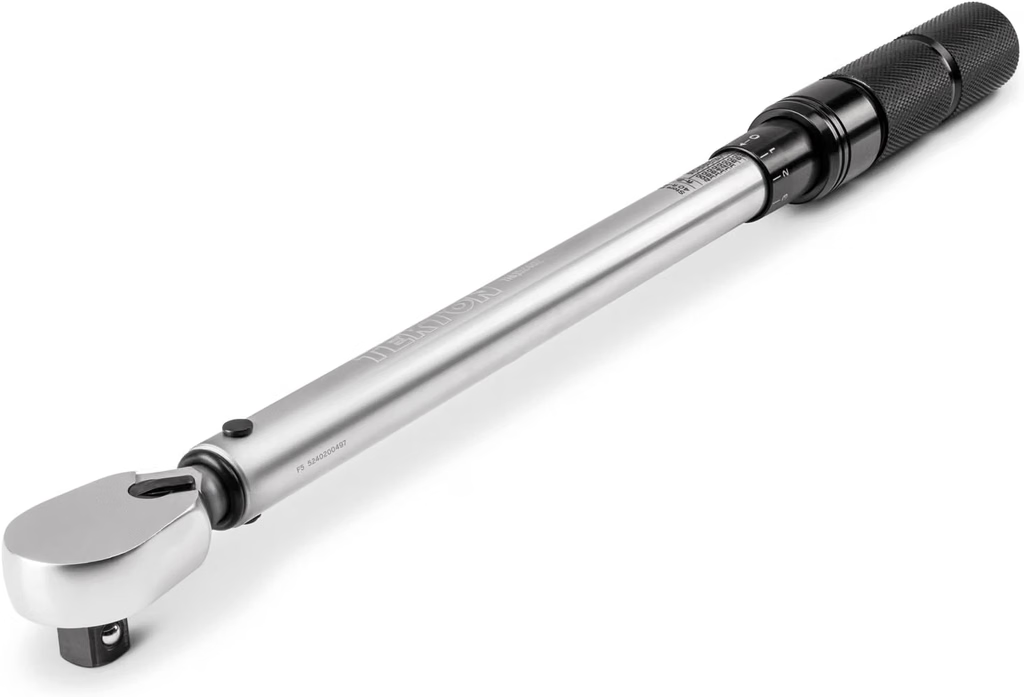
1. TEKTON 24335 1/2-Inch Click Torque Wrench: Best Overall
This is the wrench I recommend to anyone building a first serious toolkit. The 10 to 150 ft-lb band covers lug nuts, brake calipers, suspension bolts and most fasteners on a passenger vehicle. The click is loud and you feel it through the handle, which matters when you are working under a car with the radio on.
The all-steel body has no plastic collar to crack, and the dual-range scale is laser etched rather than printed. It ships in a blow-moulded case with a calibration certificate.
| Range | 10 to 150 ft-lb |
| Accuracy | +/- 4% clockwise |
| Head | Reversible ratcheting |
| Best for | General automotive and DIY |
Pros
- Loud, unmistakable click
- Etched scale will not wear off
- Excellent value for the accuracy
Cons
- Clockwise accuracy only
- Must be wound down after use
- Too coarse for sub 10 ft-lb work
Verdict: 9.2/10. The default answer for most buyers. Accurate, tough and priced so you can afford a second wrench in a different range.
2. CDI 2503MFRPH: Best Professional Grade
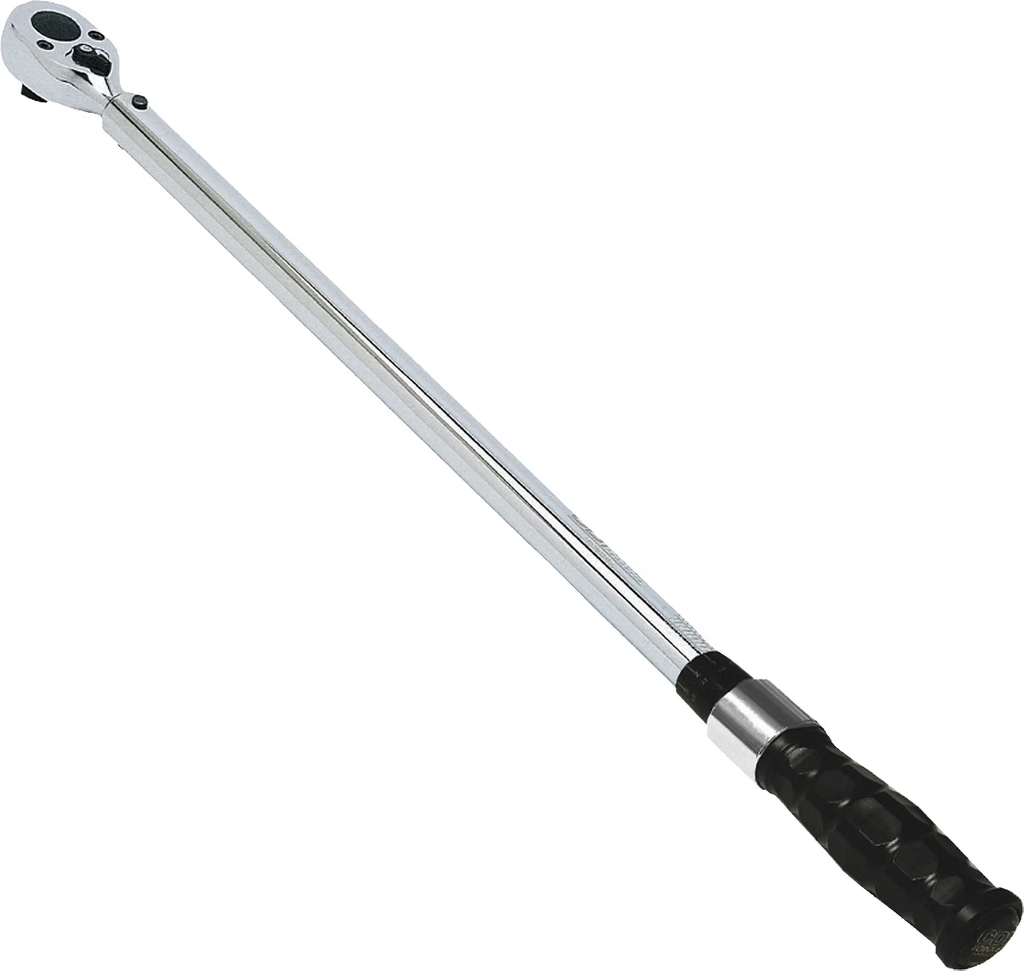
CDI is a Snap-on subsidiary, and this wrench is built to the tolerances that implies. Clockwise accuracy is rated at plus or minus 3 percent, which is inside the ISO 6789 requirement rather than merely meeting it. The micrometer adjustment is firm and the locking collar does not drift.
The 30 to 250 ft-lb range suits heavier chassis work, truck lug nuts and suspension components. It is a lifetime purchase if you send it out for calibration on schedule.
| Range | 30 to 250 ft-lb |
| Accuracy | +/- 3% CW, +/- 6% CCW |
| Adjustment | Micrometer with lock |
| Best for | Professional and heavy chassis work |
Pros
- Tighter than standard tolerance
- Certificate traceable for shop records
- Rebuildable rather than disposable
Cons
- Premium pricing
- Range starts too high for light work
- Heavier than budget alternatives
Verdict: 9.5/10. The choice when documentation and repeatability are part of the job description.
3. ACDelco ARM601-4 Digital Torque Wrench: Best Digital
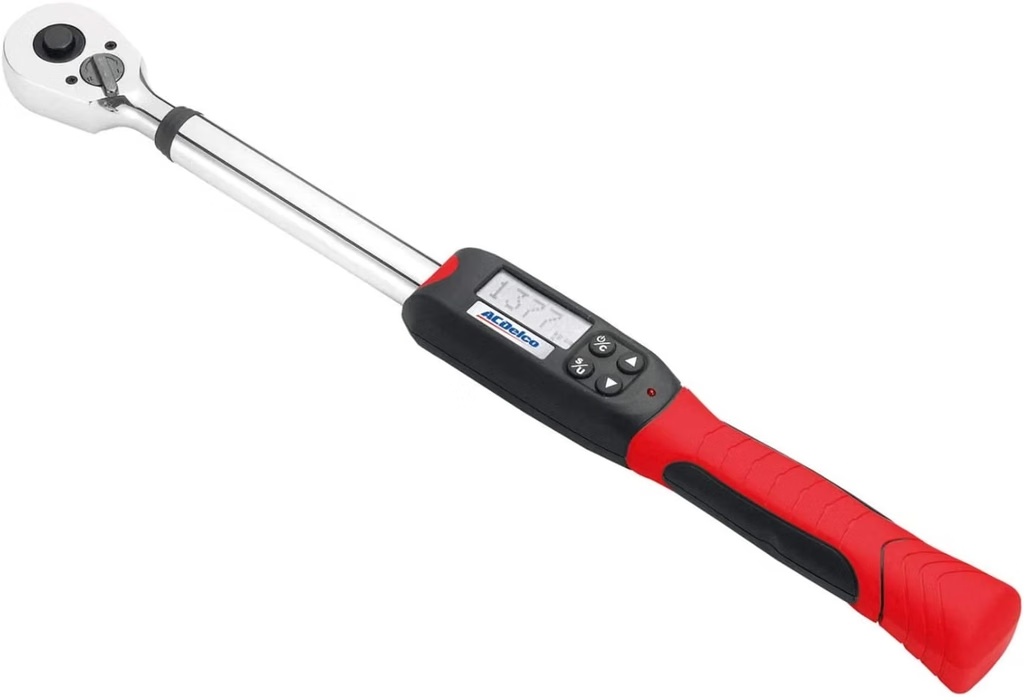
Digital wrenches solve two problems at once: unit conversion and the moment of doubt. This one holds plus or minus 2 percent clockwise and switches between ft-lb, in-lb and Nm with a button, which is useful on modern vehicles where the service manual is metric and your sockets are not.
The buzzer, LED and vibration alert fire together as you approach the target. Peak mode holds the highest reading so you can check what you applied after the fact.
| Range | 12.5 to 250 ft-lb |
| Accuracy | +/- 2% CW, +/- 3% CCW |
| Units | ft-lb, in-lb, Nm |
| Best for | Mixed metric and imperial work |
Pros
- Tightest accuracy in this lineup
- Wide range in a single tool
- Peak hold confirms what you applied
Cons
- Needs batteries
- Screen is hard to read overhead
- Electronics dislike damp storage
Verdict: 9.0/10. Best accuracy per dollar, provided you keep spare batteries in the case.
4. Precision Instruments PREC3FR250F: Best Split-Beam
The split-beam design removes the one maintenance step people forget. There is no spring held in compression, so you can leave it at any setting without losing calibration. For a wrench that lives in a service truck, that is a real advantage.
The flex head reaches fasteners that a fixed head cannot, and the adjustment dial is on the head rather than the handle, so your grip position never changes the setting.
| Range | 25 to 250 ft-lb |
| Accuracy | +/- 4% |
| Head | Flex, 15 degrees each way |
| Best for | Field work and awkward access |
Pros
- No wind-down required
- Flex head reaches buried fasteners
- Holds calibration under rough handling
Cons
- Click is softer than a standard clicker
- Costs more than comparable click models
- Flex head adds a learning curve
Verdict: 9.1/10. The practical pick if your wrench gets thrown in a truck instead of a drawer.
5. Park Tool TW-5.2: Best for Bikes and Low Torque
Most bicycle fasteners you touch regularly sit in the 4 to 6 Nm window, and carbon components crack well before a 1/2-inch wrench would register anything. The Park Tool TW-5.2 covers 2 to 14 Nm at plus or minus 4 percent.
It reads both left and right hand threads, which matters on pedals. The same range is useful well beyond bikes, covering electronics enclosures, optics mounts and small alloy castings.
| Range | 2 to 14 Nm (18 to 124 in-lb) |
| Accuracy | +/- 4% |
| Drive | 3/8 in ratcheting, reversible |
| Best for | Carbon components and delicate threads |
Pros
- Genuinely fine resolution at low torque
- Works on left hand threads
- Calibrated and cased from the factory
Cons
- Expensive for its range
- Subtle click needs a quiet room
- Not intended for loosening fasteners
Verdict: 8.8/10. Costs more than it should, and still cheaper than one cracked carbon steerer.
6. TEKTON 24320 1/4-Inch Drive: Best for Small Fasteners
Inch-pound work is where most damage happens, because people reach for a 3/8-inch ratchet and guess. Valve covers, sensors, timing covers and anything threading into plastic all need this range. The 20 to 200 in-lb band at plus or minus 4 percent covers nearly all of it.
It is the cheapest insurance in this guide. One stripped sensor boss costs more than the wrench. For panel and terminal work, pair it with a set of insulated screwdrivers rated to the same standard of care.
| Range | 20 to 200 in-lb |
| Accuracy | +/- 4% clockwise |
| Scale | Dual, in-lb and Nm |
| Best for | Sensors, covers and plastic threads |
Pros
- Fills the range most kits ignore
- Same build quality as the 1/2-inch model
- Low cost relative to the damage it prevents
Cons
- Narrow application band
- Clockwise accuracy only
- Small sockets sold separately
Verdict: 8.9/10. Buy it alongside a 1/2-inch wrench rather than instead of one.
Scored Summary
| Model | Award | Score |
|---|---|---|
| CDI 2503MFRPH | Best professional grade | 9.5 |
| TEKTON 24335 | Best overall | 9.2 |
| Precision Instruments PREC3FR250F | Best split-beam | 9.1 |
| ACDelco ARM601-4 | Best digital | 9.0 |
| TEKTON 24320 | Best for small fasteners | 8.9 |
| Park Tool TW-5.2 | Best for bikes | 8.8 |
Five Habits That Keep Your Readings Honest
Pull smoothly and stop at the click, because a second click adds torque you never measured. Grip at the marked point on the handle, since moving your hand changes the effective lever length. Approach the target in one continuous motion rather than a series of jerks.
Wind a click wrench back to its lowest scale setting before storage, not past the bottom of the scale. Never use a torque wrench to break fasteners loose, and never add a pipe to the handle. Run fasteners down by hand or with a cordless drill first, then switch to the torque wrench for the final pull.
Planning a bigger job? The project tool checklist lays out what else you will need, and the side-by-side comparison tool lets you put any two of these wrenches head to head.
Frequently Asked Questions
How often should a torque wrench be calibrated?
Every 12 months or 5,000 cycles, whichever comes first. Check it immediately after any drop.
Is a click or digital torque wrench more accurate?
Digital models typically claim 2 to 3 percent versus 4 percent for click types. Both are fine for general work, and both drift without calibration.
Can I use a torque wrench to loosen bolts?
No. Breakaway torque on a corroded fastener can exceed the tool’s rated capacity and damage the mechanism.
Do I need to wind the wrench back to zero?
Wind back to the lowest number on the scale, not below it. Split-beam wrenches skip this step entirely.
What size torque wrench should I buy first?
A 1/2-inch drive covering roughly 10 to 150 ft-lb handles the widest range of vehicle work. Add a 1/4-inch inch-pound wrench second.
Final Word
Accurate fastening is not about buying the most expensive tool in the aisle. It is about owning a wrench whose range matches the fastener, using it inside its verified window, and sending it out for calibration before you start doubting it.
If you only buy one, make it the TEKTON 24335. If you work on engines or in a shop, the CDI 2503MFRPH earns its price on the first head gasket.
Still weighing your options?
Answer four quick questions and get a shortlist built around your projects.Take the Tool Finder Quiz
Also Read On>>> Best Automotive Tool Sets for Beginners
Best Air Compressors for Home Garage(2026)
Best Socket Sets for Mechanics: Top 10 Picks for Every Garage