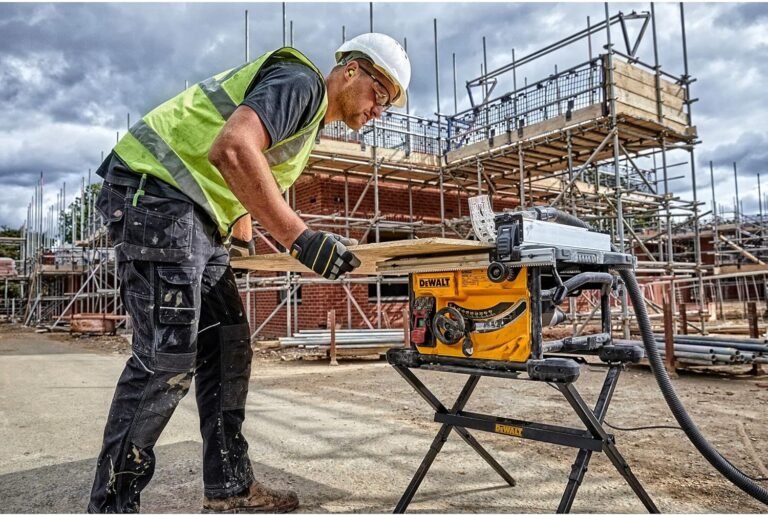
Best Dust Collector for One Car Garage Shops in 2026
Any dust collector for one car garage duty has to fit a hard box: roughly 240 square feet of floor, one or two 15 amp circuits, and a door you still want to open. Every unit below was picked against that box.
Most buying guides ignore that box and rank collectors by raw airflow, pointing you at a 3 HP cyclone that needs 220 volt service and a nine foot ceiling. In a single bay garage, that machine is a very expensive coat rack.
The right dust collector for one car garage use comes down to four things: airflow at the tool, filtration into the respirable range, amp draw on a household circuit, and footprint. Every spec below is manufacturer published data.
This post contains affiliate links. We earn a commission when you purchase through our links at no extra cost to you. We only recommend products we’ve personally tested and use ourselves.
The Short Answer
Best overall: Oneida Mini-Gorilla 1.5 HP. True cyclonic separation and HEPA grade filtration in a 28 inch by 24.75 inch footprint, which is the smallest genuinely capable package you can buy.
Best space saver: RIKON 60-101. Bolts to the wall, frees the entire floor, and still pulls 800 CFM through a 4 inch port with a 1 micron canister.
Best value: Shop Fox W1826. A 1 HP wall unit drawing only 7 amps, which matters when your garage shares one circuit with the freezer.
Why a One Car Garage Changes the Math
Dust in a small enclosed room does not disperse the way it does in a 2,000 square foot shop. It concentrates. Fewer cubic feet of air means a higher airborne concentration from the same cut, and a closed door means almost no air exchange to dilute it.
That concentration is the health issue. OSHA sets a permissible exposure limit of 15 mg/m³ for total wood dust and 5 mg/m³ for the respirable fraction, both as an eight hour time weighted average. NIOSH recommends a far stricter 1 mg/m³ for all wood dust.
The stakes are not theoretical. The International Agency for Research on Cancer classified wood dust as a Group 1 carcinogen in 1995, linked to cancers of the nasal cavity, paranasal sinuses and nasopharynx. The US National Toxicology Program followed in 2002.
Particle size separates a tidy shop from a safe one. Particles above 10 microns are caught in your nose and throat, while the 0.5 to 5 micron fraction reaches the alveoli and can stay there indefinitely. That fraction is invisible, so the chip pile under your saw tells you nothing about it.
How Much CFM You Actually Need
Size the collector for your single hungriest machine, not the total of every tool you own. You run one machine at a time and blast gates close the rest, which saves most people several hundred dollars.
Published requirements at the machine port sit in a tight band. A table saw wants roughly 350 to 450 CFM, a jointer 350 to 450, a planer 400 to 600, a miter saw 300 to 500, a bandsaw around 350, and a router table 200 to 400.
So your target at the tool is 400 to 600 CFM. The trap is that rated CFM is measured at the inlet with minimal restriction, and no collector delivers that number at the far end of a hose.
Duct losses are badly underestimated. A 10 foot run with two 90 degree elbows can cut output by 30 to 40 percent, since each elbow costs about as much as 10 feet of straight pipe. Undersizing the main to 4 inches on a 1.5 HP unit can choke it to roughly 60 percent of rated flow.
Velocity matters as much as volume. Wood chips stay suspended between about 3,500 and 4,500 feet per minute, and below that they drop out and pack your horizontal runs solid. Keep hose runs under 10 feet, stay at 4 inches minimum, and buy 1.5 times your largest machine’s requirement.
Filtration Is the Spec Most Buyers Get Wrong
Filter rating is where cheap collectors give the game away. A standard 30 micron bag captures chips and passes almost everything respirable straight back into the room. Survivable in an open industrial building, not in your closed garage.
Treat 5 micron as the floor, 2 micron as acceptable, and 1 micron or HEPA grade as the target. HEPA media captures 99.97 percent of particles at 0.3 microns, right in the range that reaches your alveoli.
Pleated canisters beat bags twice over. More surface area in the same height keeps airflow high as the filter loads, and they clean without releasing a cloud. Shaking a loaded bag in a small garage defeats the whole point.
Two stage cyclones go further by separating debris before it ever touches the filter. Oneida rates its cyclone at separating over 99 percent of bulk debris and fine dust into the bin. The filter stays clean, airflow stays near rated, and you empty a bin instead of wrestling a bag.
Power and Footprint Limits in a Single Bay
A 120 volt, 15 amp circuit gives you 1,800 watts before the breaker trips, and continuous load guidance puts the practical ceiling nearer 1,440 watts. That is roughly 1.5 HP of collector, and only if nothing else meaningful shares the circuit.
Check amp draw before horsepower. The Shop Fox W1826 draws 7 amps, the JET DC-1100VX draws 11 amps at 115 volts, and the WEN DC1300 draws 14 amps. That last figure trips a shared circuit the moment your compressor kicks in.
Footprint is the other hard limit, and wall mounted units give back every square foot they occupy. Garages also have hard reflective surfaces, and single stage collectors commonly sit at 70 to 80 dB. Keep hearing protection on the wall next to the switch.
Specs at a Glance
| Model | Motor | Rated Airflow | Filtration | Mounting |
|---|---|---|---|---|
| Oneida Mini-Gorilla | 1.5 HP, 120V / 16A | 600 actual CFM | HEPA grade, 0.3 micron | Mobile, 28 x 24.75 in |
| RIKON 60-101 | 1 HP TEFC, 120/240V | 800 CFM at 4 in | 1 micron canister | Wall mounted |
| JET DC-1100VX-CK | 1.5 HP, 115/230V, 11A | 1,100 CFM at 4 in | 2 micron canister | Four casters |
| Shop Fox W1826 | 1 HP, 120/240V, 7A | 537 CFM | 2.5 micron bag | Wall mounted |
| WEN DC1300 | 14A motor, 3,450 RPM | 1,300 CFM | 5 micron bag | Mobile base |
| RIKON 60-105 | 1 HP | 660 CFM at 4 in | 2 micron cloth bag | Casters or wall brackets |
1. Oneida Mini-Gorilla 1.5 HP: Best Overall
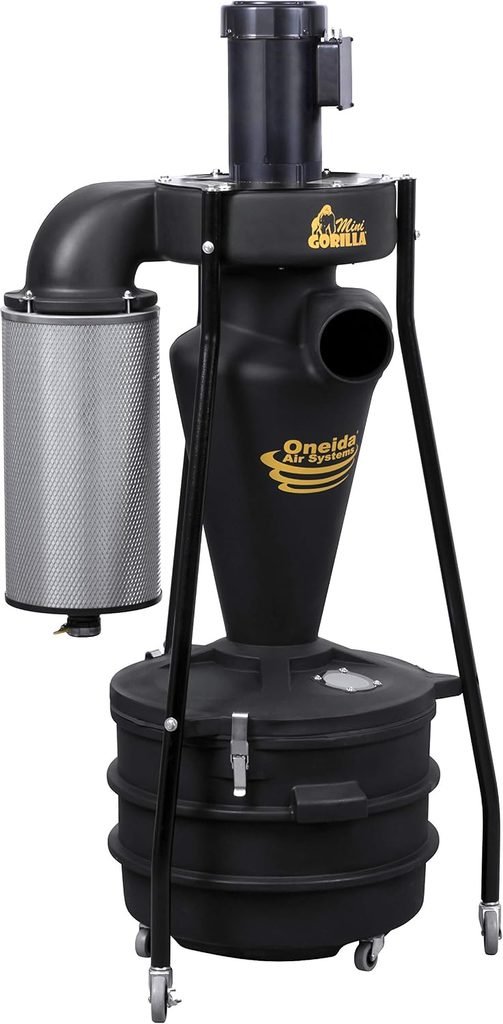
Oneida built this for shops where the collector moves from tool to tool. It weighs 85 pounds and occupies a 28 inch by 24.75 inch footprint, roughly the floor space of a shop vac on a cart.
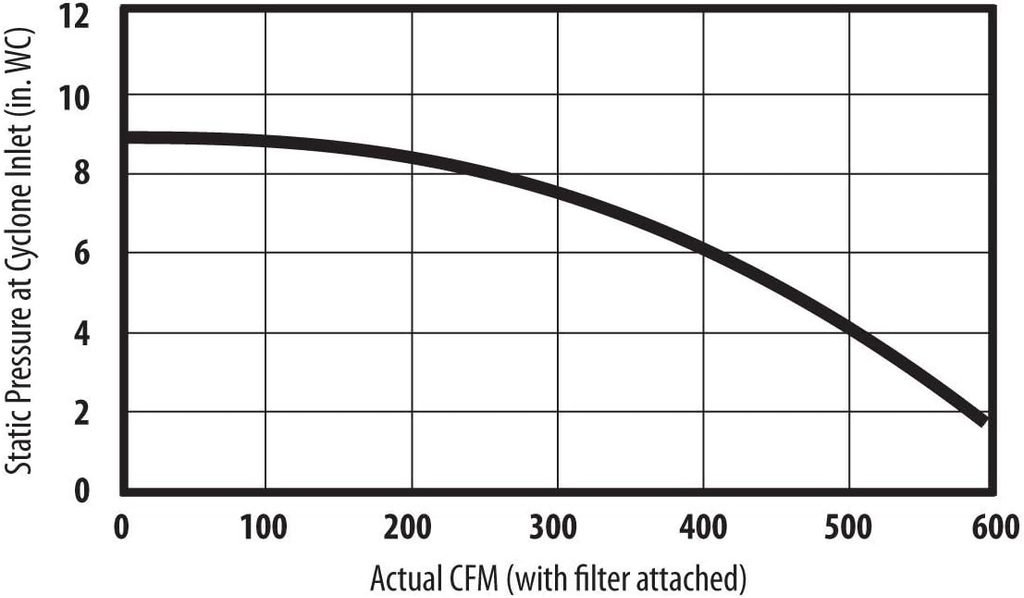
You are paying for the two stage layout. The tall molded cyclone drops over 99 percent of debris into a 22 gallon bin before air reaches the HEPA grade cartridge, so airflow holds near its rated 600 actual CFM instead of decaying.
The catch is electrical. The 120 volt version draws 16 amps and needs a 20 amp NEMA 5-20 receptacle, so budget for an electrician if your garage has only 15 amp outlets.
Pros
- HEPA grade 0.3 micron filtration
- Cyclone keeps airflow constant
- Smallest capable footprint here
- Bin empties without a dust cloud
Cons
- Needs a dedicated 20 amp outlet
- Premium pricing versus single stage
- Bin clamp alignment takes practice
Verdict: 9.4 / 10. If your garage doubles as a space you breathe in regularly, this is the one that solves the actual problem rather than tidying the floor.
2. RIKON 60-101 Wall Mount: Best Space Saver
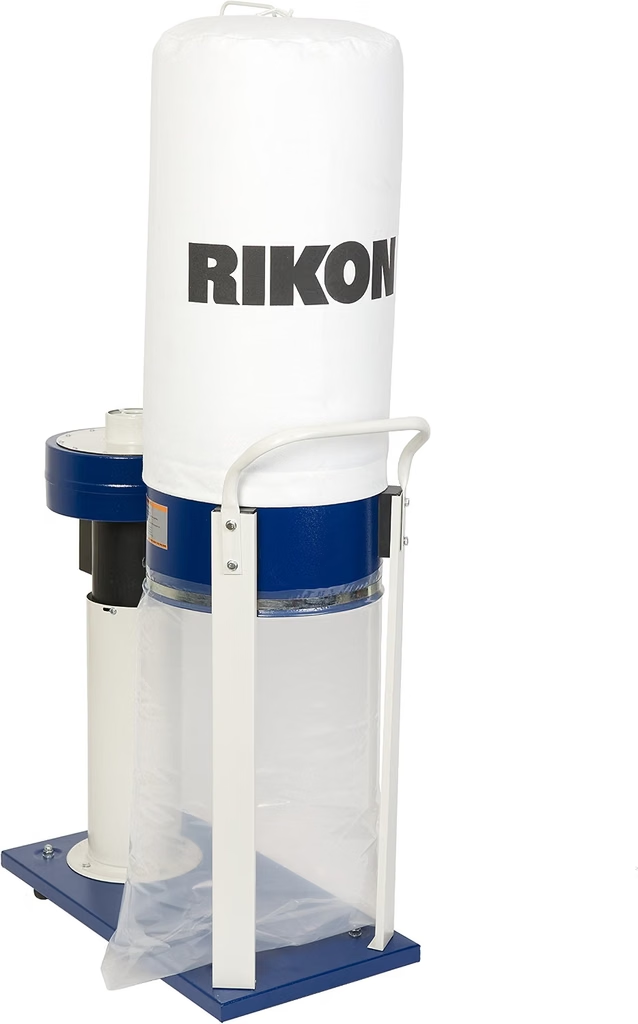
This is the answer when floor space, not budget, is the binding constraint. It bolts to studs above or beside your primary machine and returns its entire footprint to you.
The 10 inch spiral impeller moves 800 CFM through a 4 inch inlet, or 1,100 CFM if you step up to the 5 inch option. That is genuinely strong for a 1 HP motor, and the pleated canister is rated to 1 micron, which is better filtration than most units twice the price.
A dual 4 inch inlet with a cap lets you hard plumb two machines and switch by moving the cover. The 1.5 cubic foot debris bag is small, so expect frequent changes if you run a planer.
Pros
- Zero floor space consumed
- 1 micron pleated canister
- Dual inlet serves two machines
- 120V or 240V wiring
Cons
- Small 1.5 cubic foot bag
- Fixed position once mounted
- Needs solid stud mounting
Verdict: 9.1 / 10. The best airflow per square foot of floor on this list, and the 1 micron canister means you are not trading filtration for space.
3. JET DC-1100VX-CK: Best for a Ducted Garage System
Pick this if you plan short fixed ductwork to three or four machines rather than dragging a hose. The rated 1,100 CFM at 4 inches and 10.5 inches of static pressure give you the headroom duct losses will eat.
The Vortex Cone is the design feature worth understanding. It improves chip separation before the filter, which delays clogging and packs the collection bag more efficiently, giving you some of the benefit of a cyclone in a single stage cabinet.
You get one 6 inch port or two 4 inch ports, and the 5.3 cubic foot bag means far fewer emptying trips than the RIKON. It is tall, so measure your ceiling first.
Pros
- Strongest static pressure here
- Vortex Cone delays filter clogging
- 6 inch or dual 4 inch inlets
- Large 5.3 cubic foot bag
Cons
- Tall cabinet needs ceiling height
- 11 amps at 115V
- 2 micron, not HEPA grade
Verdict: 8.9 / 10. The right choice when you want permanent ducting in a small shop and need airflow that survives a few elbows.
4. Shop Fox W1826: Best Budget Wall Mount
The W1826 earns its place on amp draw alone. At 7 amps on 120 volts, it is the only unit here you can run on a shared garage circuit without nuisance tripping.
Rated at 537 CFM with 7.2 inches of static pressure, it is built for short direct hose runs rather than a duct network. That logic holds up in a single bay where nothing sits more than a few feet away.
Filtration is the compromise. The 2.5 micron bag is acceptable rather than good, and the 2 cubic foot capacity fills quickly. A bag window and bottom zipper at least make emptying easy.
Pros
- Only 7 amps on 120V
- Frees all floor space
- Light at 55 pounds
- Bag window and zipper
Cons
- 2.5 micron bag filtration
- Lowest airflow on this list
- Not suited to ducted runs
Verdict: 8.5 / 10. The sensible entry point for a garage with tired wiring. Budget for a canister filter upgrade later.
5. WEN DC1300: Best Big Capacity Value
The headline number is 1,300 CFM from a 14 amp motor spinning a 10 inch steel impeller at 3,450 RPM. Dual 4 inch inlets let you connect two tools, and the vertical 50 gallon bag means you can go a long time between emptyings.
That capacity earns its keep if you run a planer, which buries a small bag in one session. The mobile base is included, so you can park it against a wall and roll it out.
Two caveats matter in a one car garage. The 5 micron stock bag sits at the bottom of the acceptable range, and 14 amps is very close to the ceiling of a 15 amp circuit. Treat a canister filter upgrade as part of the purchase price.
Pros
- Highest rated airflow here
- 50 gallon collection bag
- Dual 4 inch inlets
- Mobile base included
Cons
- 5 micron stock filtration
- 14 amps strains a 15A circuit
- Tall bag needs headroom
Verdict: 8.0 / 10. Strong airflow per dollar, held back by stock filtration that you should plan to replace.
6. RIKON 60-105: Best Flexible Portable
This 1 HP portable draws 660 CFM through a single 4 inch port, covering a table saw, jointer or bandsaw. Built in casters and a carry handle make repositioning easy.
The standout feature is the adjustable pipe extension with a chip collecting funnel. Raise it and you get overhead capture for a lathe, drill press or workbench, exactly the tools with no usable dust port.
It ships with a 2 micron cloth bag, a 108 inch hose and wall brackets, so you can start portable and go wall mounted later. The bag needs shaking, which is best done outdoors.
Pros
- Adjustable funnel for lathes
- Portable or wall mounted
- Long 108 inch hose included
- 2 micron bag as standard
Cons
- Bag filter needs shaking
- Single inlet only
- Modest airflow for a planer
Verdict: 8.2 / 10. The most adaptable unit here, and the obvious pick if turning or benchtop work dominates your shop time.
Scored Summary
Scores below weight footprint and filtration more heavily than raw airflow, because those are the specs a dust collector for one car garage work actually lives or dies on.
| Model | Best For | Editorial Score |
|---|---|---|
| Oneida Mini-Gorilla | Best overall, cleanest air | 9.4 |
| RIKON 60-101 | Tight floor space | 9.1 |
| JET DC-1100VX-CK | Short ducted systems | 8.9 |
| Shop Fox W1826 | Limited circuit capacity | 8.5 |
| RIKON 60-105 | Lathes and benchtop work | 8.2 |
| WEN DC1300 | Airflow on a budget | 8.0 |
Whichever unit you choose, pair it with a fitted respirator and eye protection during heavy sanding. Our guide to anti-fog safety glasses covers the lenses that survive a dusty garage without constant wiping.
Frequently Asked Questions
Is a shop vac enough for a one car garage?
A shop vac moves roughly 100 to 150 CFM, which suits sanders and routers but not a table saw or planer. Those need 350 CFM or more at the port. Pairing a shop vac with a cyclone separator is an interim step, not a permanent answer.
Do I need 220 volt power for a dust collector?
No. Every unit here runs on 120 volts, though the Oneida needs a 20 amp receptacle. A 15 amp circuit caps out near 1,800 watts, roughly 1.5 HP of collector.
What micron rating should I look for?
Treat 5 micron as the minimum, 2 micron as acceptable and 1 micron or HEPA grade as the target. Particles under 10 microns are respirable, so anything coarser leaves the harmful fraction circulating.
Should I wall mount or go portable?
Wall mount if your machines stay put and floor space is scarce, which describes most one car garages. Go portable if you reconfigure often or need overhead capture for a lathe.
Does a dust collector replace an air filtration unit?
No, they do different jobs. A collector captures dust at the source while an ambient air cleaner scrubs what escapes. In a small garage, running both beats either alone.
Still Weighing Two Options?
Put any two of these collectors head to head on the specs that matter for your shop, or work through the full setup list before you buy.
Compare Tools Side by Side Project Tool Checklist
Also read >>> 5 Best Table Saws for Hobbyists and Woodworkers in 2026
>>>Best Torque Wrenches for Accurate Fastening
>>>Best Thermal Imaging Camera for Electrical Inspection (2026): 6 Expert Picks