Best Portable Generators for Home Backup Power in 2026
Our Verdict at a Glance
If you want one machine that covers a whole house during a multi-day outage, the Westinghouse WGen9500DF is the pick. It runs on gasoline or propane, starts by remote key fob, and feeds a transfer switch through a single 30-amp outlet.
- Best overall: Westinghouse WGen9500DF
- Best for large homes and heavy loads: DuroMax XP13000HX
- Best value mid-size: Champion 100165 Dual Fuel
- Best fuel flexibility: Firman T07571 Tri Fuel
- Best quiet inverter: Honda EU2200i
- Best inverter for essentials plus RV: Westinghouse iGen4500
- Best gas-free alternative: EcoFlow DELTA Pro 3
Power outages in the United States are getting longer, not shorter. The Energy Information Administration reports that the average customer lost about 11 hours of electricity in 2024, roughly double the average of the previous decade, with major storms accounting for 80 percent of those lost hours . That is the gap a portable generator is built to close.
This guide ranks the best portable generators for home backup power by the things that actually decide whether your fridge stays cold: usable running watts, fuel flexibility, transfer switch compatibility, noise, and carbon monoxide protection. I have specified and commissioned standby and backup power for residential clients as a licensed electrical engineer, and the mistakes are always the same. People buy too small, they skip the transfer switch, and they put the machine too close to the house.
Every pick below is sized against real household loads, not marketing peak watts. Read the buying guide first if you are not sure what size you need, because that single decision matters more than brand.
This post contains affiliate links. We earn a commission when you purchase through our links at no extra cost to you. We only recommend products we’ve personally tested and use ourselves.
How to Choose a Portable Generator for Home Backup
Start With Running Watts, Not Peak Watts
Peak watts is a surge number that a generator can hold for a few seconds while a motor spins up. Running watts is what it delivers continuously, and that is the figure that decides what you can actually keep on. A generator advertised at 12,500 peak watts may only give you 9,500 running watts.
Add up the running wattage of everything you want on at once, then add the single largest starting surge on top. A typical refrigerator draws around 150 to 200 running watts but can spike past 1,000 watts on startup. A half-horsepower sump pump runs near 1,050 watts and surges to about 2,150 watts.
Here is a quick sizing rule that works for most homes.
- 3,500 to 5,000 running watts: essentials only, meaning fridge, lights, router, phone charging, and a furnace fan
- 7,500 to 9,500 running watts: essentials plus a well pump, sump pump, or window air conditioner
- 10,000 running watts and up: central air conditioning or an electric water heater
Choose Your Fuel Before You Choose Your Brand
Gasoline is cheap and available, but it goes stale in about 30 days without stabilizer, and gas stations cannot pump it when the grid is down. Propane stores for years, starts cleanly in cold weather, and burns without gumming a carburetor. Natural gas never runs out during an outage because it comes off your utility line, but it delivers roughly 10 to 20 percent less power than gasoline.
Dual fuel units run gasoline and propane. Tri fuel units add natural gas, which requires a plumber to fit a quick-connect line. For a house that loses power for several days at a time, dual fuel is the practical floor and tri fuel is the upgrade worth paying for.
Inverter or Conventional
Conventional open-frame generators give you the most watts per dollar and the most 240-volt capability. Inverter generators produce cleaner power with total harmonic distortion typically under 3 percent, which matters for laptops, medical equipment, and modern appliance control boards. Inverters are also dramatically quieter because the engine throttles down under light load.
For whole-house backup through a transfer switch, a conventional dual fuel unit is usually the right buy. For a quiet machine you can also camp with, choose an inverter.
You Need a Transfer Switch
Running extension cords through a window works for a fridge and a lamp. It does not work for a furnace, a well pump, or anything hardwired. A transfer switch or an interlock kit connects the generator to your panel and isolates it from the utility line.
Backfeeding a panel through a dryer outlet, sometimes called a suicide cord, can energize the utility line outside your home and kill a lineworker. It is illegal in every US jurisdiction I am aware of. Budget for a licensed electrician to install a proper transfer switch, and confirm your generator has a matching 30-amp or 50-amp outlet before you buy.
Carbon Monoxide Is the Real Risk
This is the part of the buying decision people skip. The Consumer Product Safety Commission estimates that about 100 people die each year in the US from carbon monoxide poisoning caused by portable generators, and more than 200 die annually from consumer product CO poisoning overall . One portable generator can emit as much carbon monoxide as hundreds of cars.
Run the generator outdoors only, at least 20 feet from the house, with the exhaust pointed away from windows, doors, and vents. Never run one in a garage, shed, basement, or carport, even with the door open. Buy a model with a CO shutoff sensor certified to UL 2201 or ANSI/PGMA G300, and install battery-backed CO alarms on every level of your home.
Noise, Weight, and Runtime
Anything under 60 dBA is conversation-quiet, 65 to 70 dBA is a normal open-frame unit at distance, and above 75 dBA will annoy neighbors and may breach local ordinances. Check your city noise rules before you buy a big open-frame machine.
Weight matters more than buyers expect. A 9,500-watt unit typically weighs 200 to 250 pounds, so wheel kits and handle design are not luxuries. Look for at least 10 hours of runtime at 50 percent load so you are not refuelling in the dark.
Portable Generator Comparison Table
| Model | Best For | Running Watts | Fuel | Start | Score |
|---|---|---|---|---|---|
| Westinghouse WGen9500DF | Best overall | 9,500 gas | Dual | Remote key fob | 9.4 |
| DuroMax XP13000HX | Large homes | 10,500 gas | Tri | Electric | 9.2 |
| Champion 100165 | Best value | 7,500 gas | Dual | Electric | 9.0 |
| Firman T07571 | Fuel flexibility | 7,500 gas | Tri | Electric | 8.8 |
| Honda EU2200i | Quiet essentials | 1,800 | Gasoline | Recoil | 8.9 |
| Westinghouse iGen4500 | Inverter plus RV | 3,700 | Gasoline | Remote | 8.6 |
| EcoFlow DELTA Pro 3 | No emissions | 4,000 | Battery | Instant | 8.7 |
1. Westinghouse WGen9500DF, Best Overall Portable Generator for Home Backup
The WGen9500DF is the machine I recommend most often to homeowners who want one solution and no second thoughts. It delivers 9,500 running watts on gasoline and around 8,500 on propane, which covers a fridge, freezer, furnace, well pump, lights, and a window air conditioner at the same time. The 30-amp transfer switch outlet means it drops straight into a properly installed interlock or transfer panel.
The remote key fob start is the feature owners talk about most. Starting a 200-plus pound generator from your back door during a freezing storm is a real quality of life difference. Runtime lands near 12 hours at 25 percent load on a full tank.
Specifications
| Peak / running watts (gas) | 12,500 / 9,500 |
| Peak / running watts (propane) | 11,200 / 8,500 |
| Fuel type | Dual fuel, gasoline and propane |
| Outlets | 120/240V, 30A transfer switch outlet, 50A, four 120V household |
| Starting | Remote key fob, electric, recoil backup |
| Warranty | Three year limited with nationwide service network |
Pros and Cons
Pros
- Covers nearly all household essentials at once
- Remote key fob start in bad weather
- Transfer switch ready out of the box
- Strong dealer and parts support in the US
Cons
- Loud compared with any inverter
- Heavy enough that one person struggles on soft ground
- No natural gas option
Verdict: 9.4 / 10. The best balance of output, fuel flexibility, and real-world usability for whole-house backup. Buy this if you want to stop researching.
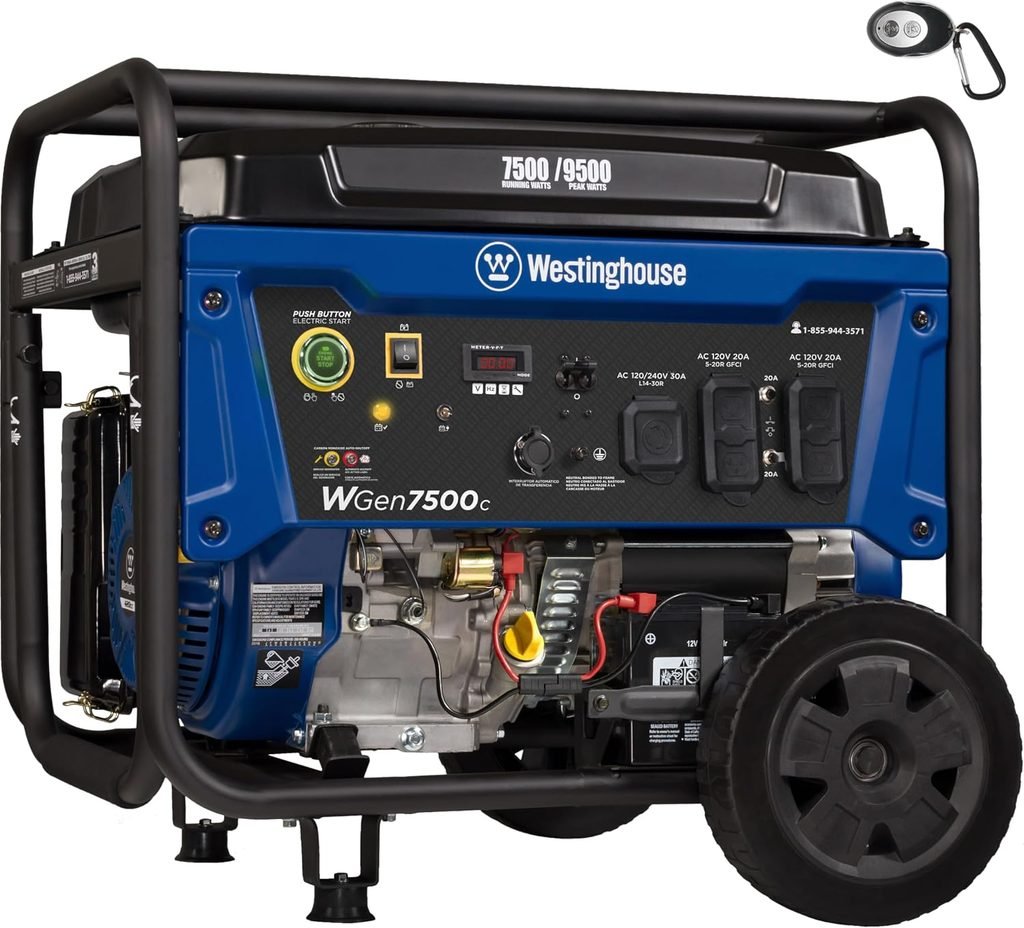
2. DuroMax XP13000HX, Best for Large Homes and Heavy Loads
When a client has central air, an electric water heater, or a deep well pump, the 9,500-watt class starts to feel tight. The XP13000HX answers that with 10,500 running watts and true tri fuel operation across gasoline, propane, and natural gas. The natural gas hookup is the reason to buy it, because a utility gas line does not run dry after three days.
It also includes a CO Alert shutoff sensor, which cuts the engine if carbon monoxide builds around the unit. That does not replace the 20-foot rule, but it is a genuine safety layer. The trade-off is weight and noise, since this is a big steel-framed machine.
Specifications
| Peak / running watts (gas) | 13,000 / 10,500 |
| Fuel type | Tri fuel, gasoline, propane, natural gas |
| Safety | CO Alert automatic shutoff sensor |
| Outlets | 120/240V including 50A and 30A transfer switch outlet |
| Starting | Electric push button with recoil backup |
| Frame | All metal with heavy duty wheel kit |
Pros and Cons
Pros
- Natural gas capability for unlimited outage runtime
- Handles central air and well pump loads
- CO shutoff sensor built in
- Durable all-metal construction
Cons
- Very heavy and awkward on gravel or grass
- Natural gas conversion needs a licensed plumber
- Output drops noticeably on natural gas
Verdict: 9.2 / 10. The right answer for a bigger house or a longer outage, provided you have somewhere flat to park it.
3. Champion 100165 Dual Fuel, Best Value Mid-Size Generator
Most homes do not actually need 10,000 watts. The Champion 100165 sits in the sweet spot at 7,500 running watts on gasoline, which comfortably runs a fridge, freezer, furnace blower, sump pump, lights, and electronics together. It is usually the least expensive credible route into transfer switch backup.
Champion’s cold start technology and volt guard surge protection are the practical extras here. Owners consistently report easy starting in winter, which is when you need it. Support is a standing strength for the brand, with lifetime technical help from US-based staff.
Specifications
| Peak / running watts (gas) | 9,375 / 7,500 |
| Peak / running watts (propane) | 8,400 / 6,750 |
| Fuel type | Dual fuel, gasoline and propane |
| Outlets | 120/240V with 30A transfer switch outlet |
| Starting | Electric with recoil backup |
| Support | Three year limited warranty, lifetime technical support |
Pros and Cons
Pros
- Best output per dollar in this roundup
- Reliable cold weather starting
- Lighter and easier to move than the 10,000 watt class
- Excellent US customer support reputation
Cons
- Not enough for central air conditioning
- No natural gas option
- Louder than an inverter at low loads
Verdict: 9.0 / 10. The value pick. If your load list stops short of central air, this is the smart money.
4. Firman T07571 Tri Fuel, Best Fuel Flexibility on a Budget
Tri fuel usually carries a premium, and Firman undercuts that. The T07571 delivers 7,500 running watts on gasoline and switches to propane or natural gas through a front panel selector. For homes with a gas meter, that turns a portable into something close to a semi-permanent backup source.
The engine is a Firman Max Pro series unit with a cast iron sleeve, and the frame carries a useful never-flat wheel kit. Output drops on natural gas as it does on every tri fuel machine, so size for the fuel you plan to use most.
Specifications
| Peak / running watts (gas) | 9,400 / 7,500 |
| Fuel type | Tri fuel, gasoline, propane, natural gas |
| Fuel switching | Front panel selector, no tools |
| Outlets | 120/240V with 30A transfer switch outlet |
| Starting | Electric with recoil backup |
| Mobility | Never-flat wheel kit and folding handle |
Pros and Cons
Pros
- Cheapest genuine tri fuel route to natural gas
- Tool-free fuel switching
- Solid wheel kit for one-person moves
- Good runtime at half load
Cons
- Smaller dealer network than Champion or Generac
- Noticeable wattage loss on natural gas
- No remote start
Verdict: 8.8 / 10. Buy it if you have a natural gas line and want tri fuel without paying premium brand pricing.
5. Honda EU2200i, Best Quiet Inverter for Essentials
Not everyone needs to run the whole house. If your goal is a fridge, a few lights, a router, phone charging, and a CPAP machine, the EU2200i does that at 48 to 57 dBA, which is quieter than normal conversation. It weighs about 47 pounds, so one person can carry it.
Honda’s reputation here is earned rather than marketed. The inverter output is clean enough for sensitive electronics and medical equipment without a second thought. The limitation is obvious, since 1,800 running watts will not touch a well pump or central air.
Specifications
| Starting / running watts | 2,200 / 1,800 |
| Noise level | 48 to 57 dBA |
| Weight | Approximately 47 pounds |
| Runtime | Up to roughly 8 hours on a single tank |
| Parallel capable | Yes, pair two units for more output |
| Power quality | Inverter, safe for laptops and medical devices |
Pros and Cons
Pros
- Quiet enough to run overnight in a suburb
- Light enough for one person to carry
- Exceptional long-term reliability record
- Can be paralleled with a second unit
Cons
- Far too small for whole-house backup
- Expensive per watt
- Gasoline only, no propane option
Verdict: 8.9 / 10. The best small generator money can buy, as long as you understand it is an essentials machine.
6. Westinghouse iGen4500, Best Inverter for Essentials Plus RV Use
The iGen4500 bridges the gap between a tiny inverter and a full open-frame unit. At 3,700 running watts it holds a fridge, freezer, furnace fan, lights, and electronics, and it does that at around 52 dBA. The 30-amp RV outlet makes it a dual-purpose buy for households that camp.
Runtime is the standout number, with up to roughly 18 hours on a full tank at quarter load. The efficiency comes from the inverter throttling the engine down instead of running flat out. There is no 240-volt output, so a well pump on a 240-volt circuit is out of scope.
Specifications
| Peak / running watts | 4,500 / 3,700 |
| Noise level | Approximately 52 dBA |
| Runtime | Up to roughly 18 hours at low load |
| Outlets | 120V household, 30A RV outlet, USB |
| Starting | Remote, electric, recoil |
| Voltage | 120V only, no 240V output |
Pros and Cons
Pros
- Very long runtime for its size
- Quiet enough for close neighbors
- Clean inverter power for electronics
- Doubles as an RV and tailgating generator
Cons
- No 240V output limits transfer switch use
- Gasoline only
- Enclosed case makes servicing fiddlier
Verdict: 8.6 / 10. A quiet, efficient middle ground for essentials backup that earns its keep the rest of the year.
7. EcoFlow DELTA Pro 3, Best Gas-Free Alternative
A battery power station is not a generator, but for many households it is the better answer. The DELTA Pro 3 produces no carbon monoxide, so it can sit in a kitchen or basement, which matters enormously for apartment dwellers and anyone without safe outdoor space. It delivers 4,000 watts of output from a 4,096Wh lithium iron phosphate battery.
Capacity is expandable with extra battery packs, and it recharges from solar, a wall outlet, or your car. The honest limitation is duration, because once the battery is flat you need sunlight or grid power to refill it. Pairing one with a small gas generator is the setup I most often recommend to clients who want quiet nights and long endurance.
Specifications
| AC output | 4,000W, higher with surge boost mode |
| Battery capacity | 4,096Wh lithium iron phosphate, expandable |
| Emissions | None, indoor safe operation |
| Noise | Near silent under normal load |
| Recharging | AC wall, solar, vehicle, generator |
| Cycle life | Thousands of cycles typical of LFP chemistry |
Pros and Cons
Pros
- Zero carbon monoxide risk, usable indoors
- Silent operation, no neighbor complaints
- No fuel storage, oil changes, or carburetors
- Solar recharging extends runtime indefinitely
Cons
- Highest cost per watt in this roundup
- Finite stored energy without solar input
- Heavy for its physical size
Verdict: 8.7 / 10. The safest backup power you can own, and the only option that works in an apartment.
Scored Summary
Here is how the best portable generators for home backup power score against each other on the four criteria that decide daily satisfaction. Power and value carry the most weight for whole-house use, while noise matters most in dense neighborhoods. Scores are out of ten.
| Model | Power | Fuel Flexibility | Noise | Value | Overall |
|---|---|---|---|---|---|
| Westinghouse WGen9500DF | 9.6 | 9.0 | 7.5 | 9.3 | 9.4 |
| DuroMax XP13000HX | 9.8 | 9.7 | 7.0 | 8.7 | 9.2 |
| Champion 100165 | 8.8 | 8.5 | 7.4 | 9.6 | 9.0 |
| Firman T07571 | 8.7 | 9.6 | 7.3 | 9.0 | 8.8 |
| Honda EU2200i | 6.5 | 6.0 | 9.8 | 8.0 | 8.9 |
| Westinghouse iGen4500 | 7.6 | 6.2 | 9.4 | 8.8 | 8.6 |
| EcoFlow DELTA Pro 3 | 7.9 | 8.0 | 10.0 | 7.6 | 8.7 |
Generator Safety Rules That Are Not Optional
Half of generator carbon monoxide deaths happen in the coldest four months of the year, when people are tempted to bring the machine closer to the house for warmth or shelter. Do not do it. Keep the exhaust at least 20 feet away and pointed away from the building.
Let the engine cool before refuelling, since spilled gasoline on a hot muffler ignites. Store fuel in approved containers away from living space. Keep the generator dry under an open canopy, never in an enclosed space.
Test the unit twice a year, run it under load, and change the oil on schedule. A generator that has sat untouched for two years is not backup power, it is a heavy lawn ornament. For wider outage planning, has a solid checklist.
Frequently Asked Questions
What size portable generator do I need to run my whole house?
Most American homes need 7,500 to 9,500 running watts to cover essentials plus a well pump or sump pump. Add central air conditioning or an electric water heater and you are looking at 10,000 running watts or more. Add up your running loads first, then add the biggest single starting surge.
Can a portable generator power a refrigerator and a furnace at the same time?
Yes, comfortably. A fridge draws roughly 150 to 200 running watts and a gas furnace blower typically draws 600 to 800 watts. Even a 3,500-watt generator handles both, provided it can absorb the fridge compressor surge.
Is dual fuel worth the extra cost?
For home backup it usually is. Propane stores for years without degrading and stays available when gas stations lose power, which is exactly when you need fuel. You do give up some wattage on propane, so size the generator around its propane output if that is your main fuel.
Do I legally need a transfer switch?
If you want to power hardwired circuits such as a furnace, well pump, or lighting, then yes, a transfer switch or interlock kit is required by the National Electrical Code and should be installed by a licensed electrician. Extension cords are fine for plug-in appliances only. Backfeeding a panel through a dryer or range outlet is unsafe and illegal.
How long can a portable generator run continuously?
Most manufacturers recommend shutting down every 8 to 24 hours for oil checks and cooling. Typical runtime is 8 to 12 hours per tank at half load, though efficient inverters stretch much further at light loads. For multi-day outages, plan for refuelling, oil top-ups, and a rest cycle.
Still not sure which size fits your home?
Answer four quick questions and get a matched recommendation, or build a full outage kit list with our project checklist.
Take the Tool Finder Quiz Build Your Checklist
Related Reading on Tool Expert Reviews
Best Anti Fog Safety Glasses for Job Sites: 6 Pairs That Stay Crystal Clear
Best Electrician Tool Kits for Apprentices: 6 Sets That Build a Pro Kit Fast
How to Test a Circuit Breaker With a Multimeter in 6 Safe Steps